
Revision Thread Lifting in Apgujeong, Gangnam Seoul
Board-Certified Dermatologist Top 2% in Korea 13+ Years
Revision Thread Lifting · quick answer
What revision thread lifting involves, in one paragraph
Revision thread lifting is the assessment and correction of a previous thread lift that left problems such as asymmetry, dimpling, a visible or palpable thread, ongoing discomfort or little lift. Depending on the cause, correction may mean waiting for swelling to settle, releasing or removing a thread, placing new threads along better vectors, or using fillers, HIFU or RF instead. At Ever Skin Clinic, a board-certified dermatologist examines the face, often with ultrasound, before recommending anything.
Medically reviewed by Dr. Jieun Kim, M.D. Founder & Director, board-certified dermatologist. Dermatology residency at Hanyang University Hospital; adjunct professor, Hanyang University College of Medicine. Meet our dermatologists Last reviewed October 2026
- Addresses
- Asymmetry, dimpling, visible or palpable threads, weak lift, discomfort
- Assessment
- Examination, often with ultrasound imaging to locate threads
- Options
- Observation, thread release or removal, re-threading, fillers or devices
- Downtime
- Varies; often a few days of swelling or bruising
- Timing
- Depends on when the original threads were placed and how the tissue has healed
The treatment
What is revision thread lifting?
Most problems after thread lifting come from thread choice, depth or vector: a thread placed too shallow can show or pucker the skin, uneven tension can cause asymmetry, and threads unsuited to the tissue may give little lift. Some early irregularities settle by themselves as swelling resolves, so the first step is always a careful assessment rather than immediate re-treatment.
Revision is more demanding than a first thread lift because tissue may already be scarred or altered. Our dermatologists plan it around your anatomy, and sometimes a device such as HIFU or volume correction is a better choice than more threads.
What a revision plan may include
- Observation — giving minor dimples or swelling time to settle
- Release or removal — freeing or extracting a visible, palpable or painful thread where feasible
- Re-threading — new dissolvable threads placed along corrected vectors once tissue has healed
- Volume correction — fillers where the original problem was volume loss rather than sagging
- Device lifting or skin treatment — HIFU, RF or RF microneedling for laxity or texture
Is it right for you?
Who should consider a revision consultation?
A revision consultation is worth booking if you are unhappy with the result of a thread lift done at our clinic or elsewhere. Bring any information you have about the thread type, number and date of your procedure; it helps us plan safely.
If you have signs of infection such as increasing pain, heat, redness or discharge, seek medical review promptly rather than waiting for a cosmetic revision.
Common reasons patients come to us
- Uneven or asymmetrical lift
- A thread that can be seen or felt under the skin
- Dimpling or puckering that has not settled
- Little or no visible lift
- Persistent tightness, pain or irritation
Your visit
How a revision is assessed and done
Because every case differs, your plan and timing are agreed only after examination.
- Detailed history Your dermatologist reviews when and how the previous threads were placed and what concerns you.
- Examination and imaging The face is examined at rest and in movement, often with ultrasound to locate existing threads.
- Correction Under local anaesthetic, threads may be released or removed, or new threads, fillers or devices used as planned.
- Review We check healing and symmetry at follow-up and adjust the plan if further steps are needed.
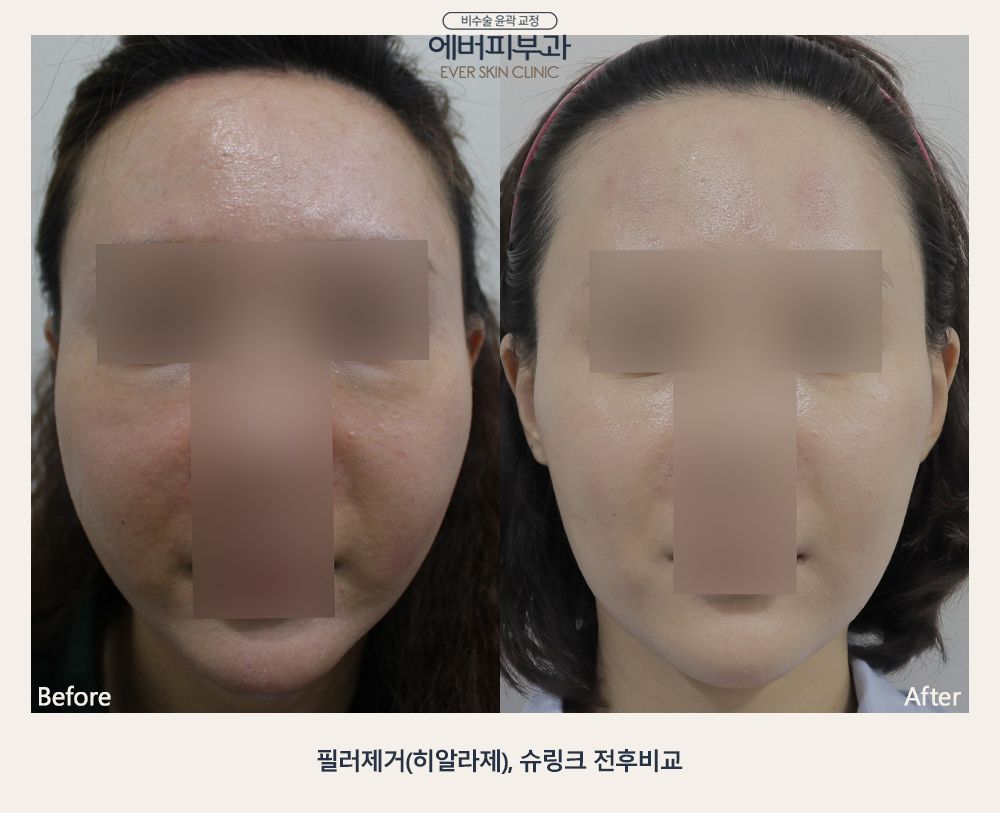
Real patient · before & after
Correcting earlier treatment, then lifting
This patient had previous filler dissolved with hyaluronidase and was then treated with Shurink HIFU. It is shown as an example of how we correct earlier work before lifting; it is not a thread revision case.
Every revision depends on what was done before, so ask us at consultation for cases similar to yours.
Photos are shared with the patient's consent and are not retouched apart from privacy blurring. Results differ from person to person and are not guaranteed.
See more before & after photosRecovery & safety
Recovery, side effects and aftercare
After revision, swelling, bruising and tenderness for several days are common. Removing a thread may leave a small entry mark, and it is not always possible to extract every fragment, especially from older threads that have bonded with tissue. Risks of new threads are similar to a first thread lift, including asymmetry, infection and irregularity.
Tell your dermatologist if you take blood thinners, have a bleeding disorder, an autoimmune condition or keloid tendency, have permanent fillers in the area, or are pregnant or breastfeeding.
Aftercare tips
- Avoid massaging or rubbing the treated area for about 2 weeks
- Limit wide mouth opening and hard chewing if new threads were placed
- Skip saunas, intense exercise and alcohol for about a week
- Keep entry points clean and follow any wound-care instructions
- Report increasing pain, redness or swelling to the clinic promptly
Questions we hear every day
Revision Thread Lifting FAQ
Can all threads be removed?
Not always. Threads close to the surface or recently placed can often be released or removed, but older threads may have partly dissolved or bonded with tissue. Your dermatologist will explain what is realistically removable after examination, sometimes with ultrasound imaging.
How long should I wait after my first thread lift?
Minor dimples and asymmetry often improve over two to four weeks as swelling settles, so early waiting is sometimes the right advice. Problems such as a protruding thread or signs of infection need earlier review. Re-threading is usually planned after tissue has healed.
Does revision hurt?
It is performed under local anaesthetic, so most patients feel pressure rather than sharp pain. Afterwards the area may be sore and swollen for several days. Discuss your pain tolerance with your dermatologist beforehand.
Can you correct a thread lift done at another clinic?
Yes, we assess patients treated elsewhere, including abroad. Bring any records of the thread brand, type, number and date. If records are unavailable, examination and ultrasound help us understand what was placed.
Is revision possible during a short trip?
Assessment and simple corrections can often be done during a visit. Because swelling and bruising can last several days and follow-up matters, allow some time in Seoul after treatment. Your dermatologist may recommend staged care if re-threading is needed.
Talk to a board-certified dermatologist in Apgujeong
Send us your skin concern and photos on WhatsApp. An English-speaking team member will reply and arrange your consultation.
Mon & Thu 10:00–19:00 · Tue & Fri 10:00–20:00 · Sat 10:00–16:00 · Closed Wed, Sun & holidays