
Tear Trough Filler in Apgujeong, Gangnam Seoul
Board-Certified Dermatologist Top 2% in Korea 13+ Years
Tear Trough Filler · quick answer
What tear trough filler does, in one paragraph
Tear trough filler is a precise injection of soft, elastic hyaluronic acid (HA) into the tear trough, the groove that runs from the inner corner of the eye down and outward toward the cheek. Filling this groove reduces the shadow it casts, which often reads as a dark circle, and smooths the lower lid-to-cheek transition. At Ever Skin Clinic, board-certified dermatologists use microcannulas, careful attention to vessel anatomy and conservative amounts to avoid puffiness.
Medically reviewed by Dr. Jieun Kim, M.D. Founder & Director, board-certified dermatologist. Dermatology residency at Hanyang University Hospital; adjunct professor, Hanyang University College of Medicine. Meet our dermatologists Last reviewed October 2026
- Target
- Tear trough groove below the inner eye
- Filler type
- Soft, elastic, low-swelling HA
- Technique
- Microcannula, deep placement, low-pressure injection
- Downtime
- Mild swelling or bruising, usually under a week
- Duration
- Often around 9 to 18 months; varies
The treatment
What is the tear trough, and why fill it?
The tear trough is a natural groove where the thin eyelid skin meets the thicker cheek. With age, genetics or weight loss, the support beneath it thins and the groove deepens, creating a line of shadow that makes eyes look tired even after rest. A small amount of soft HA placed deep, close to the bone, can lift the floor of the groove so light reflects more evenly.
Tear trough filler is the most technically demanding part of under eye filler. It is often combined with front cheek filler for support, and with laser toning or exosome therapy when pigment or skin quality also contribute.
Our safety principles for the tear trough
- Microcannula for most placement, to reduce bruising and vessel injury
- Anatomy-guided entry points chosen around known vessel paths
- Low-pressure, slow injection in small amounts
- Soft, low-swelling HA suited to thin skin
- Conservative dosing — under-correction is safer than puffiness
Is it right for you?
Who is a good candidate?
The best candidates have a visible groove from the inner corner of the eye, reasonably firm skin and little puffiness or fluid retention. People in their twenties to forties with a hereditary tear trough often see the clearest change.
Tear trough filler is less suitable if you have large under-eye fat bags, very loose eyelid skin or daily morning puffiness. In these cases your dermatologist may suggest lifting, skin treatments or a surgical opinion. See fillers for dark circles for how we tell the causes apart.
Tear trough filler may suit you if you
- Have a groove running down from the inner eye
- Look tired despite enough sleep
- Have mild to moderate hollowing without big bags
- Have reasonably firm under-eye skin
- Want a subtle change without surgery
Your visit
What happens during treatment
Allow about 45 minutes in clinic; the injection itself takes a few minutes per side.
- Mapping Your dermatologist examines the groove in different lights and positions and plans entry points away from key vessels.
- Numbing Numbing cream is applied and the skin is disinfected.
- Cannula injection A blunt microcannula delivers small amounts of soft HA deep along the groove with slow, low-pressure injection.
- Review We check the result sitting upright and offer a review at about two weeks, when any small top-up is safer than overfilling on day one.
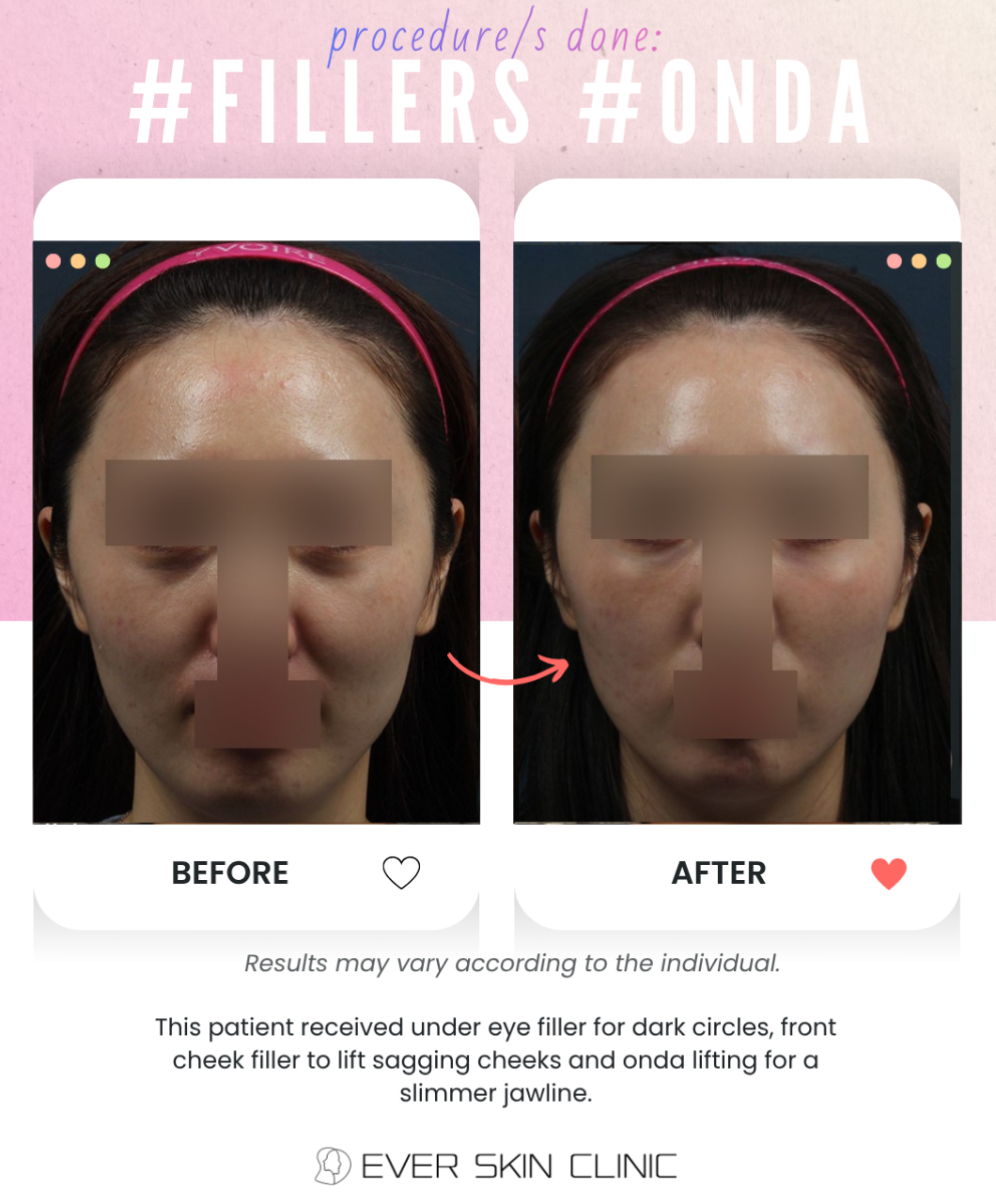
This patient had under-eye filler for dark circles and hollowness, with front-cheek filler to support the midface and Onda lifting for the jawline. The change shown reflects the whole plan, not one treatment alone.
Softer dark circles as part of a balanced plan
Dark circles can come from hollowness, pigment, thin skin or visible vessels, so your dermatologist first identifies the cause and then explains what is realistic for you.
Ask us for tear trough cases at consultation, and your dermatologist will explain what each part of a plan is expected to change.
Photos are shared with the patient's consent and are not retouched apart from privacy blurring. Results differ from person to person and are not guaranteed.
See more before & after photosRecovery & safety
Recovery, side effects and aftercare
Mild swelling, tenderness and small bruises are common and usually settle within a few days to a week. Puffiness, visible lumps or a bluish tint (Tyndall effect) can occur if filler sits too shallow or too much is used; these can usually be corrected with hyaluronidase. Vascular occlusion is rare but serious and needs immediate treatment.
Tell your dermatologist about previous under-eye filler or eyelid surgery, frequent puffiness, thyroid eye problems, allergies, blood thinners, or pregnancy or breastfeeding. Contact the clinic urgently for pain, skin colour change or any change in vision.
Aftercare tips
- Apply gentle cool compresses on the first day
- Sleep with your head slightly raised for a night or two
- Avoid alcohol, salty food, saunas and hard exercise for 2 to 3 days
- Do not rub your eyes or massage the area
- Wait about two weeks before deciding on any top-up
Questions we hear every day
Tear Trough Filler FAQ
What is the difference between tear trough and under eye filler?
They overlap. Tear trough filler targets the specific groove from the inner eye corner, while under eye filler can also include the outer lid-cheek junction. Your dermatologist decides which zones need product based on your anatomy.
Is tear trough filler safe?
In experienced hands it is generally safe, but it is one of the most delicate filler areas. We reduce risk with blunt microcannulas, anatomy-guided entry points, slow injection and small amounts. Rare risks, including vascular occlusion, will be explained before treatment.
Will I look puffy afterwards?
Some swelling is normal for a few days. Persistent puffiness usually comes from too much filler, superficial placement or fluid retention. We use conservative amounts of low-swelling HA, and filler can be dissolved if needed.
How long does tear trough filler last?
Results often last around nine to eighteen months, sometimes longer, because the area moves little. Duration varies with product, amount and metabolism.
Can I have tear trough filler before a flight home?
Flying is generally fine. Ideally allow a few days for swelling or bruising to settle and, if possible, a two-week check. If you leave sooner, our team can review photos remotely.
Talk to a board-certified dermatologist in Apgujeong
Send us your skin concern and photos on WhatsApp. An English-speaking team member will reply and arrange your consultation.
Mon & Thu 10:00–19:00 · Tue & Fri 10:00–20:00 · Sat 10:00–16:00 · Closed Wed, Sun & holidays