
Non-Surgical Facelift in Apgujeong,
Gangnam, Seoul
Board-Certified Dermatologist Top 2% in Korea 13+ Years
Non-Surgical Facelift · quick answer
What a non-surgical facelift does, in one paragraph
A non-surgical facelift is a planned combination of treatments, rather than one device, that lifts and firms the face without incisions. Focused ultrasound (HIFU) and radiofrequency tighten deeper layers and stimulate collagen, dissolvable threads reposition sagging tissue, and fillers or collagen stimulators replace lost volume. It suits mild to moderate sagging. At Ever Skin Clinic, a board-certified dermatologist works out whether your main issue is laxity, volume loss or skin quality, then builds the plan around that.
Medically reviewed by
Dr. Jieun Kim, M.D.
Founder & Director, Ever Skin Clinic · Board-certified dermatologist
- Adjunct Professor, Hanyang University College of Medicine
- Dermatology residency, Hanyang University Hospital
- Master’s degree in Dermatology, Hanyang University
- Regular Member, Korean Dermatological Association
- Regular Member, Korean Laser Medicine Association
- Member, World Congress of Dermatology
- Published in JAAD and Annals of Dermatology
- English-speaking consultations
Meet our dermatologists → Last reviewed October 2026
- Approach
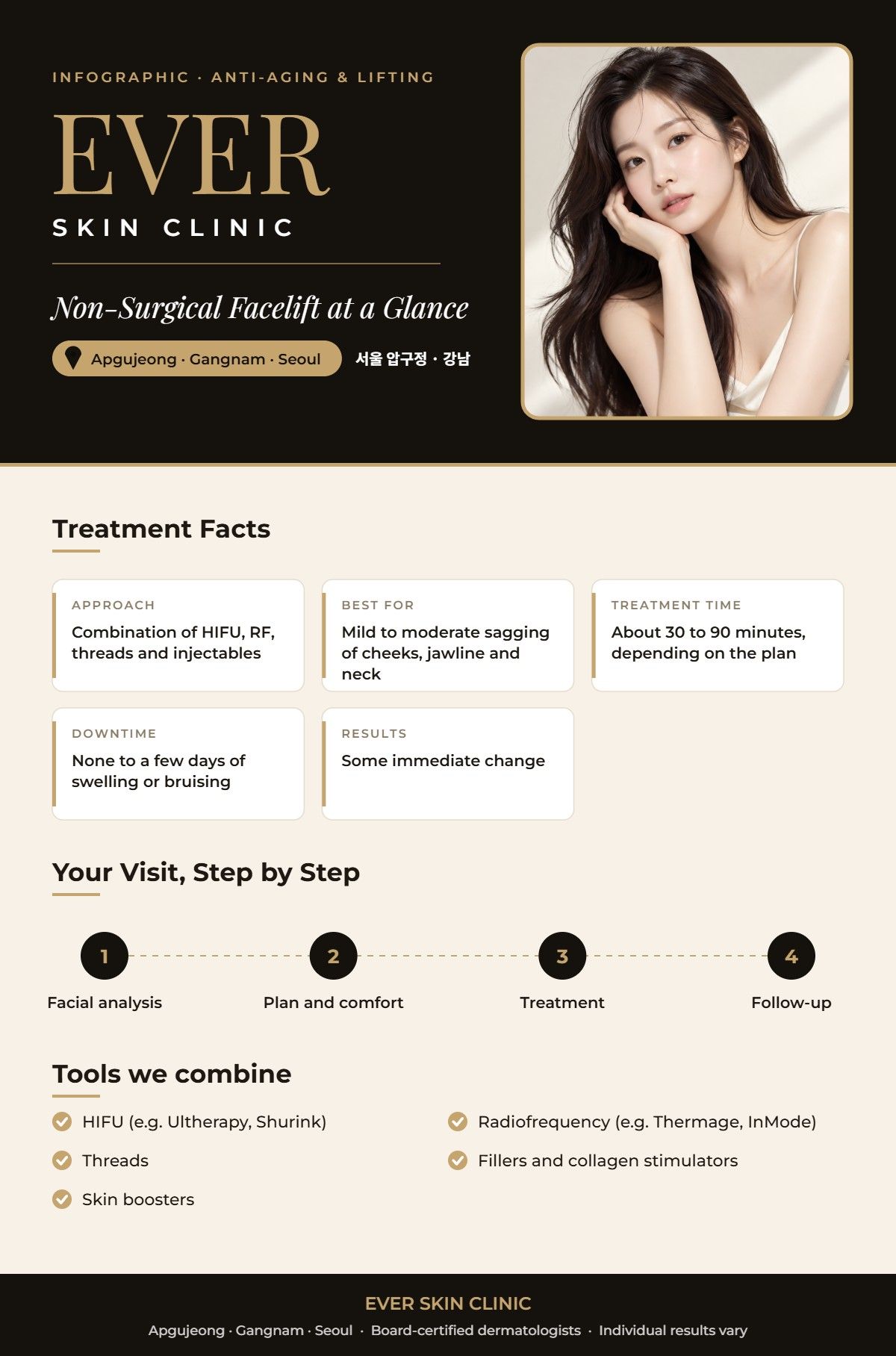
- Combination of HIFU, RF, threads and injectables
- Best for
- Mild to moderate sagging of cheeks, jawline and neck
- Treatment time
- About 30 to 90 minutes, depending on the plan
- Downtime
- None to a few days of swelling or bruising, depending on treatments chosen
- Results
- Some immediate change; collagen-based firming builds over about 2 to 3 months
The approach
What is a non-surgical facelift?
Facial ageing happens in several layers at once: the deeper support (SMAS) loosens, fat pads shrink and descend, and the skin itself thins. A surgical facelift repositions tissue through incisions; a non-surgical facelift uses several less invasive tools, each aimed at one of those layers, so the overall effect is a fresher, firmer face with little or no downtime.
The core is usually an energy-based lifting device such as Ultherapy or Thermage, sometimes with thread lifting where a more visible mechanical lift is needed. The change is more modest than surgery, and maintenance is part of the plan.
Tools we combine
- HIFU (e.g. Ultherapy, Shurink) — focused ultrasound that heats and tightens the deep SMAS layer
- Radiofrequency (e.g. Thermage, InMode) — firms skin and improves texture
- Threads — dissolvable PDO or similar threads that physically reposition tissue
- Fillers and collagen stimulators — restore volume that has been lost in the midface or temples
- Skin boosters — improve skin quality so the lift looks natural
Is it right for you?
Who is a good candidate?
The best candidates have early to moderate sagging, reasonable skin elasticity and realistic expectations. Many are in their 30s to 60s and want to delay surgery or maintain a previous result. Patients with very heavy jowls or a lot of loose skin may get more from surgery, and your dermatologist will tell you honestly if that is the case.
Because most energy devices do not target pigment, these treatments can be planned for a wide range of skin tones, with settings adjusted to your skin.
A non-surgical facelift may suit you if you want to
- Lift sagging cheeks and soften jowls
- Sharpen a softening jawline and neck
- Restore lost midface or temple volume
- Improve firmness and skin texture together
- Avoid incisions and long recovery time
Your visit
How a non-surgical facelift is planned and done
Most plans start with one main lifting treatment on the day, with any additions scheduled together or across visits to suit your stay in Seoul.
- Facial analysis A board-certified dermatologist assesses laxity, volume and skin quality and explains which treatment addresses which concern.
- Plan and comfort The combination, areas and timing are agreed, and numbing cream or local anaesthetic is applied as needed.
- Treatment Devices, threads or injectables are performed in the planned order; a session usually takes about 30 to 90 minutes.
- Follow-up We explain aftercare and suggest when to review results and plan maintenance, often every 6 to 12 months.
Real patient · before & after
What a combined plan can look like
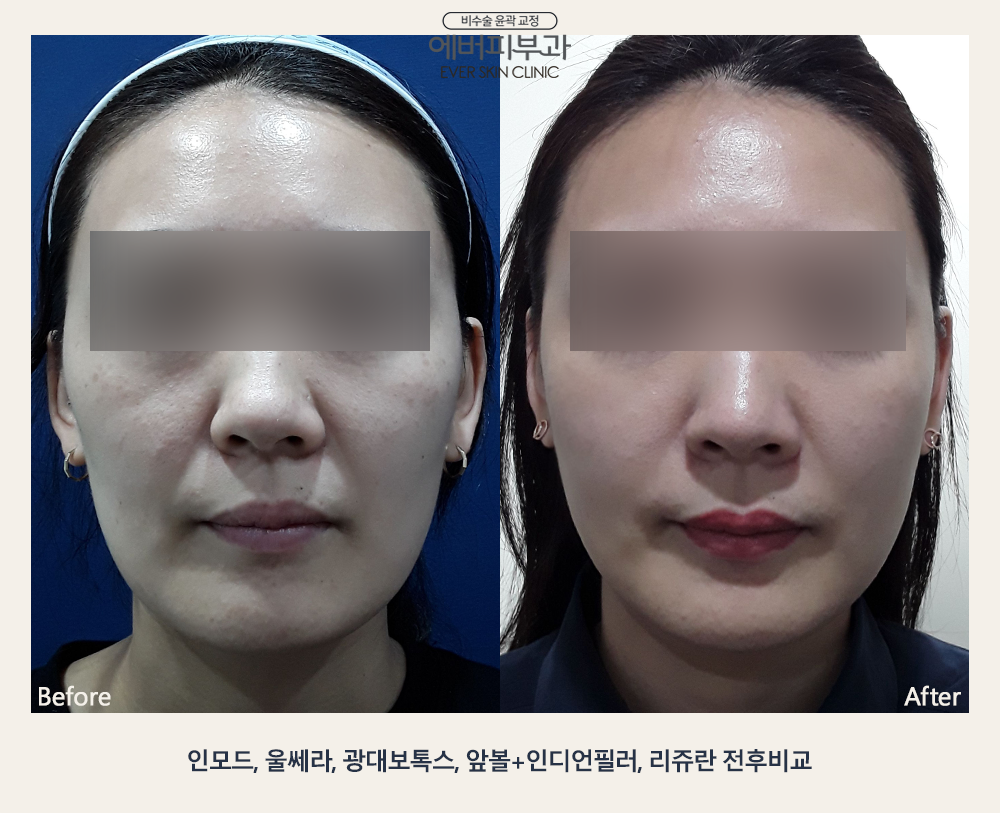
This patient received a multi-step non-surgical program: InMode and Ulthera for lifting, zygoma Botox for contour, front-cheek and Indian-line filler for volume, and Rejuran for skin quality. The change shown is the result of the whole program, which is how a non-surgical facelift is usually built.
Results vary with age, skin quality and anatomy, and your dermatologist will explain what is realistic for your face at consultation.
Photos are shared with the patient's consent and are not retouched apart from privacy blurring. Results differ from person to person and are not guaranteed.
See more before & after photosRecovery & safety
Recovery, side effects and aftercare
Recovery depends on what is included. After HIFU or RF there may be mild redness, swelling or tenderness for a day or two. Threads and fillers can add swelling, bruising or tightness for several days, and rare risks include asymmetry, nerve irritation, thread visibility or, with fillers, vascular complications.
Tell your dermatologist if you are pregnant or breastfeeding, have metal or electronic implants, take blood thinners, have an active skin infection, a bleeding disorder or an autoimmune condition, or have had previous threads or fillers in the area.
Aftercare tips
- Avoid saunas, hot baths and intense exercise for a few days
- Sleep on your back and avoid wide mouth opening after threads
- Do not massage treated areas unless told to
- Use gentle skincare and daily sunscreen
- Allow a few days of buffer before important events or flights
Questions we hear every day
Non-Surgical Facelift FAQ
How long does a non-surgical facelift last?
It depends on the treatments used. HIFU and RF results typically last around 6 to 12 months, threads often about 1 to 2 years, and fillers or collagen stimulators vary by product. Ageing continues, so most patients plan maintenance sessions rather than expecting a permanent change.
Is a non-surgical facelift as effective as surgery?
No. It gives a more subtle lift and works best for mild to moderate sagging. Surgery can remove excess skin and reposition tissue more dramatically. Many patients choose the non-surgical route to delay surgery or because they prefer minimal downtime, and your dermatologist will say if surgery would suit you better.
Does it hurt?
Sensations vary. HIFU can feel like deep heat or brief aches over bony areas, RF feels warm, and threads and fillers involve injections under local anaesthetic. Numbing cream and adjusted settings keep most patients comfortable. Tell your dermatologist about your pain tolerance in advance.
Can I have it during a short trip to Seoul?
Often yes. Device-based lifting has little downtime, so many international patients have it during a visit. If threads or fillers are included, allow several days for swelling or bruising to settle before flying home or attending events, and we can schedule around your travel dates.
How many sessions will I need?
Many plans start with a single main session, with results building over two to three months. Some combinations are spread over two visits. After that, maintenance every six to twelve months is common. Your dermatologist will suggest a schedule based on your skin and goals.
Talk to a board-certified dermatologist in Apgujeong
Send us your skin concern and photos on WhatsApp.
An English-speaking team member will reply and arrange your consultation.
Mon & Thu 10:00–19:00 · Tue & Fri 10:00–20:00 · Sat 10:00–16:00 · Closed Wed, Sun & holidays

