
Midface & Cheek Filler in Apgujeong, Gangnam Seoul
Board-Certified Dermatologist Top 2% in Korea 13+ Years
Midface / Cheek Filler · quick answer
What cheek filler does, in one paragraph
Midface or front cheek filler is an injection of hyaluronic acid (HA) or, in some cases, a collagen-stimulating filler into the front of the cheek to restore volume that flattens or descends with age. Rebuilding this support can make the face look gently lifted, soften nasolabial folds and reduce shadows under the eyes. At Ever Skin Clinic, a board-certified dermatologist maps your bone structure and fat pads before choosing the product, layer and whether to use a cannula or needle.
Medically reviewed by Dr. Jieun Kim, M.D. Founder & Director, board-certified dermatologist. Dermatology residency at Hanyang University Hospital; adjunct professor, Hanyang University College of Medicine. Meet our dermatologists Last reviewed October 2026
- Filler type
- Hyaluronic acid; collagen stimulators in selected cases
- Best for
- Flat or deflated front cheeks, midface descent, early folds
- Treatment time
- About 20 to 30 minutes including numbing
- Downtime
- Mild swelling or bruising, usually a few days
- Duration
- Often around 12 to 18 months for HA; varies
The treatment
What is midface and cheek filler?
The midface carries much of what we read as youthfulness. As cheek fat pads thin and slide down, the front cheek flattens, the under-eye groove deepens and the nasolabial fold becomes heavier. Filler placed deep over the bone and in the right fat compartments restores that support from above, which can soften the lower lines without filling them directly.
Front cheek filler differs from side cheek filler, which addresses flat or hollow lateral cheeks. Many plans combine it with under eye filler or with lifting such as Ultherapy when skin laxity is also present.
What cheek filler can help with
- Restoring soft, rounded front-cheek volume
- Supporting the under-eye to reduce shadowing
- Softening nasolabial folds by lifting from above
- Improving balance between the two sides of the face
- Not a replacement for lifting when skin is loose; it treats volume
Is it right for you?
Who is a good candidate?
Cheek filler suits people whose midface looks flat, hollow or tired, whether from ageing, weight loss or naturally low cheek projection. It is also common for younger patients who want softer, fuller front cheeks in a balanced Korean-style contour.
Your dermatologist will check skin thickness and laxity. If sagging is the main issue, adding too much volume can make the face look heavy, so lifting may come first.
Cheek filler may suit you if you
- Have flat or sunken front cheeks
- Notice deepening folds from the nose to the mouth
- Have shadowing between the under-eye and cheek
- Want a natural, non-surgical refresh
- Prefer a reversible HA option
Your visit
What happens during treatment
Most cheek filler visits take under an hour, so treatment fits easily into a stay in Seoul.
- Facial mapping Your dermatologist examines your face from the front and side, at rest and smiling, and agrees the plan with you.
- Numbing Numbing cream is applied and entry points are cleaned and marked.
- Layered injection Filler is placed in small amounts by cannula or needle, chosen by anatomy, checking symmetry as we go.
- Review We check the result sitting upright, explain aftercare and can review you at about two weeks.
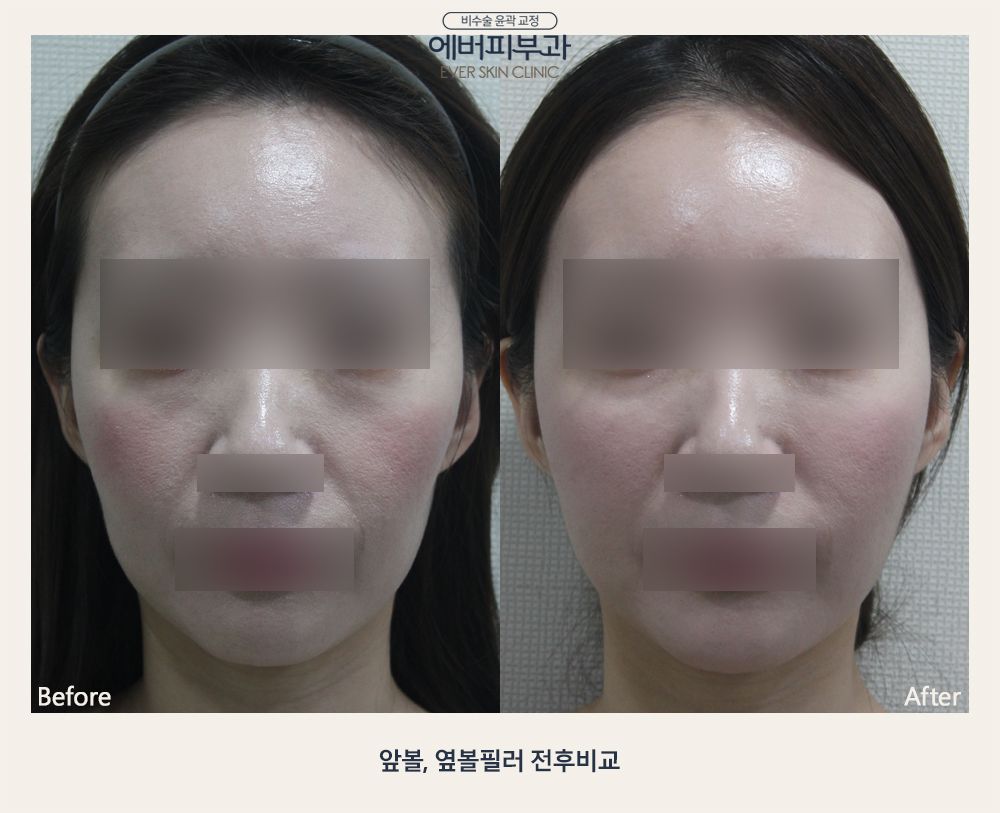
Real patient · before & after
Restoring midface support
This patient received filler to the front and side of the cheeks to rebuild midface volume. The cheeks look fuller and smoother, and the transition to the under-eye is softer.
Results depend on your structure and skin, so your dermatologist will explain what change is realistic and how much product your face actually needs.
Photos are shared with the patient's consent and are not retouched apart from privacy blurring. Results differ from person to person and are not guaranteed.
See more before & after photosRecovery & safety
Recovery, side effects and aftercare
Swelling, tenderness and occasional bruising are common for a few days; most people return to normal activities the same or next day. Lumps or asymmetry are uncommon and can usually be adjusted, and HA can be dissolved with hyaluronidase. Rare risks include infection and vascular occlusion, which needs urgent treatment.
Tell your dermatologist about previous fillers or threads, autoimmune conditions, allergies, blood thinners, recent dental work, or pregnancy or breastfeeding. Contact the clinic promptly if you notice increasing pain, blanching or skin colour change.
Aftercare tips
- Avoid pressing or massaging the cheeks unless advised
- Skip saunas, hot baths and intense exercise for 2 to 3 days
- Limit alcohol for a couple of days to reduce swelling
- Sleep on your back for the first few nights if you can
- Avoid facial treatments with strong pressure for about two weeks
Questions we hear every day
Midface / Cheek Filler FAQ
Does cheek filler hurt?
Most patients feel pressure and brief stinging rather than sharp pain. Numbing cream is applied and most HA fillers contain lidocaine. Let your dermatologist know if you are sensitive so the technique and pace can be adjusted.
How long does cheek filler last?
HA cheek filler often lasts around twelve to eighteen months, depending on the product, the amount and your metabolism. Collagen-stimulating options can last longer but are not reversible. Your dermatologist will explain the trade-offs.
Will cheek filler make my face look bigger?
It should not when placed in the right layer and amount. The aim is to restore support where volume has been lost, not to add bulk. If sagging is the main concern, your dermatologist may suggest lifting instead of more filler.
Can cheek filler fix my nasolabial folds?
It often softens them by lifting the midface, but deep folds may also need a small amount of filler in the fold itself. Your dermatologist will assess which approach gives the most natural result for your face.
Can I fly after cheek filler?
Yes, flying is generally fine after filler. Many international patients have treatment a few days before departure so early swelling settles. Avoid pressure on the cheeks, such as tight eye masks or headrests, for the first days.
Talk to a board-certified dermatologist in Apgujeong
Send us your skin concern and photos on WhatsApp. An English-speaking team member will reply and arrange your consultation.
Mon & Thu 10:00–19:00 · Tue & Fri 10:00–20:00 · Sat 10:00–16:00 · Closed Wed, Sun & holidays