
Temple Fillers in Apgujeong, Gangnam Seoul
Board-Certified Dermatologist Top 2% in Korea 13+ Years
Temple Fillers · quick answer
What temple filler does, in one paragraph
Temple filler is an injection of hyaluronic acid (HA) filler into hollow or sunken temples, the areas beside the eyes between the forehead and the cheekbone. Restoring this volume smooths the side profile of the upper face, can make prominent cheekbones look less sharp and helps the face look softer and less tired. At Ever Skin Clinic, a board-certified dermatologist uses the minimum amount needed so the temples blend smoothly without making the face look wider.
Medically reviewed by Dr. Jieun Kim, M.D. Founder & Director, board-certified dermatologist. Dermatology residency at Hanyang University Hospital; adjunct professor, Hanyang University College of Medicine. Meet our dermatologists Last reviewed October 2026
- Filler type
- Hyaluronic acid suited to deep or layered placement
- Best for
- Hollow temples; sharp cheekbone outline; slim or aged upper face
- Treatment time
- Injection takes about 5 to 10 minutes
- Downtime
- Mild swelling or tenderness for a few days
- Duration
- Often 12 to 24 months; varies by product and person
The treatment
What is temple filler?
Temples hollow with age, weight loss, intense exercise or simply a naturally slim face. A dip at the temple makes the cheekbone and brow ridge stand out and breaks the smooth curve from forehead to cheek, which can look harsh or gaunt. Filler placed deep near the bone, or in a layer above the temporal muscle with a cannula, restores a gentle, continuous line.
Temple filler is a core part of Korean-style filler planning and is often combined with forehead filler. When wide cheekbones are the concern, it may be paired with zygoma Botox for a softer outline.
What temple filler can help with
- Filling hollow or sunken temples
- Smoothing the line from forehead to cheekbone
- Making prominent cheekbones look less angular
- Softening a tired or gaunt upper face
- Not intended to change the bony width of the face
Is it right for you?
Who is a good candidate?
Good candidates have a visible dip at the temples, either from ageing or naturally, and want a softer, more connected upper-face contour. Many people do not realise their temples are hollow until they see the side profile in photos, so your dermatologist will show you in a mirror where volume is missing.
Patients with very thin skin over the temple, visible veins or prior temple treatments need careful product and depth choices, which will be discussed at consultation.
Temple filler may suit you if you
- See a hollow at the temples in profile photos
- Have cheekbones that look sharp or prominent
- Feel your upper face looks tired or gaunt
- Want a softer face shape without surgery
- Are planning other fillers for overall balance
Your visit
What happens during treatment
The injection itself is quick, so temple filler fits easily into a short stay in Seoul.
- Assessment Your dermatologist examines the temples, brow and cheekbones and agrees the amount and technique with you.
- Numbing Numbing cream is applied, with local anaesthetic at the entry point if needed.
- Injection HA is placed deep near the bone by needle or in a layered plane by cannula, in small amounts.
- Smoothing and review The contour is checked from several angles, and we explain aftercare and offer a review at about two weeks.
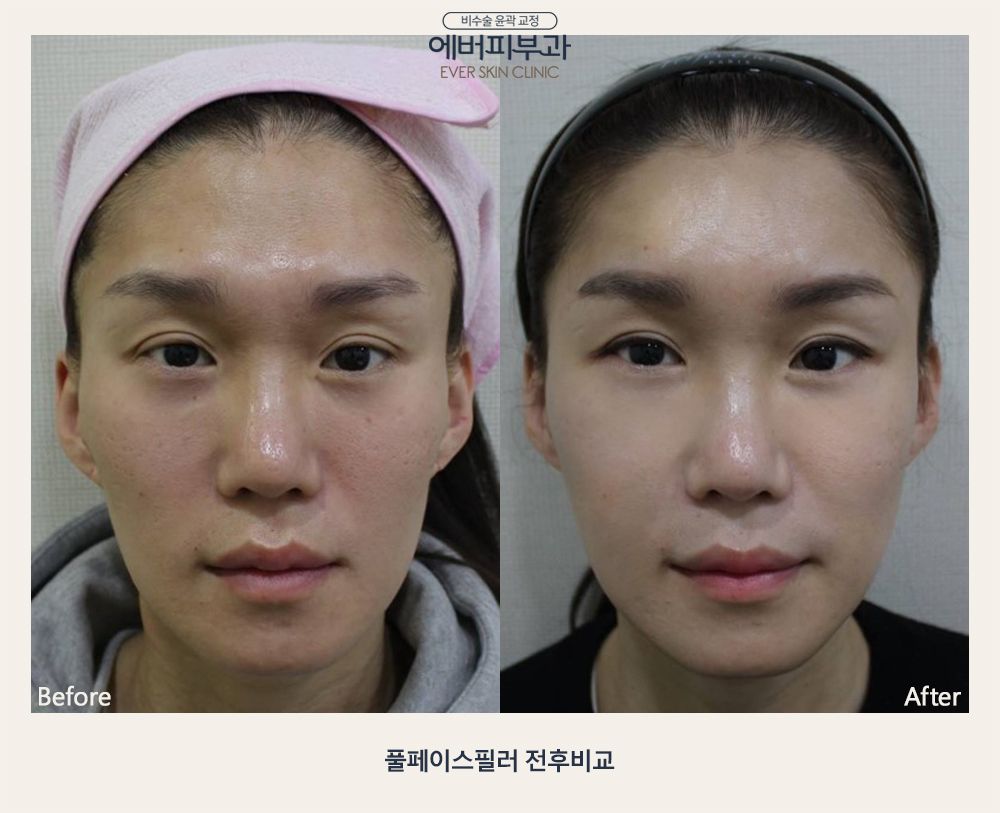
Real patient · before & after
Temples as part of a smooth facial outline
This patient received filler in several areas of the face as one plan, so the change shown is not the result of temple filler alone. We share it because temple volume is often planned together with the forehead and cheeks for a continuous contour.
Ask us for temple-specific cases at consultation, and your dermatologist will explain what each area contributes.
Photos are shared with the patient's consent and are not retouched apart from privacy blurring. Results differ from person to person and are not guaranteed.
See more before & after photosRecovery & safety
Recovery, side effects and aftercare
Mild swelling, a feeling of tightness and tenderness when chewing are common for a few days, because the temporal muscle sits beneath the area. Bruising is possible. Lumps or unevenness are uncommon and can usually be adjusted or dissolved with hyaluronidase. The temple contains important blood vessels, so vascular complications, while rare, are a key reason careful technique matters.
Tell your dermatologist about previous temple filler or surgery, migraines or jaw pain, allergies, blood thinners, or pregnancy or breastfeeding. Contact the clinic urgently for increasing pain, blanching, skin colour or vision changes.
Aftercare tips
- Avoid pressing or massaging the temples unless advised
- Avoid tight hats, headbands or glasses arms pressing on the area for a few days
- Skip saunas and intense exercise for 2 to 3 days
- Choose softer foods if chewing feels tender
- Allow about two weeks before judging the final result
Questions we hear every day
Temple Fillers FAQ
Does temple filler hurt?
Most patients feel pressure and a dull ache rather than sharp pain. Numbing cream is used, with local anaesthetic where helpful, and many fillers contain lidocaine. The injection usually takes only a few minutes.
How long does temple filler last?
Temple filler often lasts around one to two years, depending on the product, the amount and your metabolism. Some patients keep visible benefit longer. Your dermatologist will suggest when a review makes sense.
Will temple filler make my face look wider?
It should not when the amount and placement are right. Filling a hollow makes the outline smoother and can make cheekbones look less prominent, so many people look slimmer. Overfilling is what makes the upper face look wide.
Why does it hurt to chew after temple filler?
The temporal muscle, which helps you chew, lies under the temple. Pressure and swelling can make chewing feel tender for a few days. This usually settles on its own; contact the clinic if pain increases.
Can I have temple filler during a short trip?
Yes. Downtime is usually mild swelling for a few days, and flying is generally fine. Try to avoid tight eyewear or headrests pressing on the temples for the first days.
Talk to a board-certified dermatologist in Apgujeong
Send us your skin concern and photos on WhatsApp. An English-speaking team member will reply and arrange your consultation.
Mon & Thu 10:00–19:00 · Tue & Fri 10:00–20:00 · Sat 10:00–16:00 · Closed Wed, Sun & holidays