
XERF RF Lifting in Apgujeong, Gangnam Seoul
Board-Certified Dermatologist Top 2% in Korea 13+ Years
XERF · quick answer
What XERF does, in one paragraph
XERF is a dual monopolar radiofrequency (RF) lifting device that heats several skin layers with adjustable depth and intensity. Shallow settings target fine lines and texture, mid-depth settings support elasticity, and deeper settings help firm facial contours, while built-in cooling protects the surface. It suits mild to moderate laxity and patients who want natural tightening with skin-quality benefits. At Ever Skin Clinic, a board-certified dermatologist sets depth, energy and shot placement for your skin thickness and laxity.
Medically reviewed by Dr. Jieun Kim, M.D. Founder & Director, board-certified dermatologist. Dermatology residency at Hanyang University Hospital; adjunct professor, Hanyang University College of Medicine. Meet our dermatologists Last reviewed October 2026
- Technology
- Dual monopolar radiofrequency with surface cooling
- Settings
- Three treatment depths and ten energy levels, with impedance monitoring
- Best for
- Sagging contours, laxity, fine lines and uneven texture
- Downtime
- Usually none; mild redness for a few hours to a day
- Results
- Some firmness soon after; collagen effect builds over 2 to 3 months
The device
What is XERF?
Conventional monopolar RF heats a broad volume of tissue at a largely fixed depth. XERF uses two RF frequencies so energy can be directed at different layers, adjusted in real time by impedance monitoring to suit each person's skin. This allows a more three-dimensional treatment: improving texture near the surface while firming deeper support.
XERF sits alongside other monopolar RF options such as Thermage and Oligio. It is often used after or with focused ultrasound such as Ultherapy when a patient wants more precise firming as well as lift.
What XERF can help with
- Loss of definition — softening jawline and cheek contours
- Skin laxity — mild to moderate loosening
- Fine lines — through superficial-depth treatment
- Texture — smoother, more even skin
- Elasticity — firmer-feeling skin over time
Is it right for you?
Who is a good candidate?
XERF suits people with early to moderate sagging who want both lifting and skin-quality improvement, and those who prefer a natural result over an overly tight look. It can also follow treatments such as Ultherapy, Thermage or InMode when more precise firming is wanted.
For marked sagging, deeper lifting or threads may be needed alongside it. Your dermatologist will check skin thickness, laxity and facial volume before recommending.
XERF may suit you if you
- Have noticed sagging contours or reduced elasticity
- Have fine lines and texture concerns as well as laxity
- Want customised RF rather than a fixed protocol
- Prefer natural, gradual improvement
- Want lifting without surgery or prolonged downtime
Your visit
What happens during treatment
XERF has little or no downtime, so it fits easily into a stay in Seoul.
- Facial assessment A board-certified dermatologist evaluates skin thickness, laxity, volume and balance.
- Custom settings Depths, energy levels and shot placement are chosen for each area; numbing cream may be applied.
- RF treatment The cooled handpiece delivers RF across the planned zones, usually in about 30 to 60 minutes.
- Aftercare The skin is soothed and we explain what to expect as collagen builds.
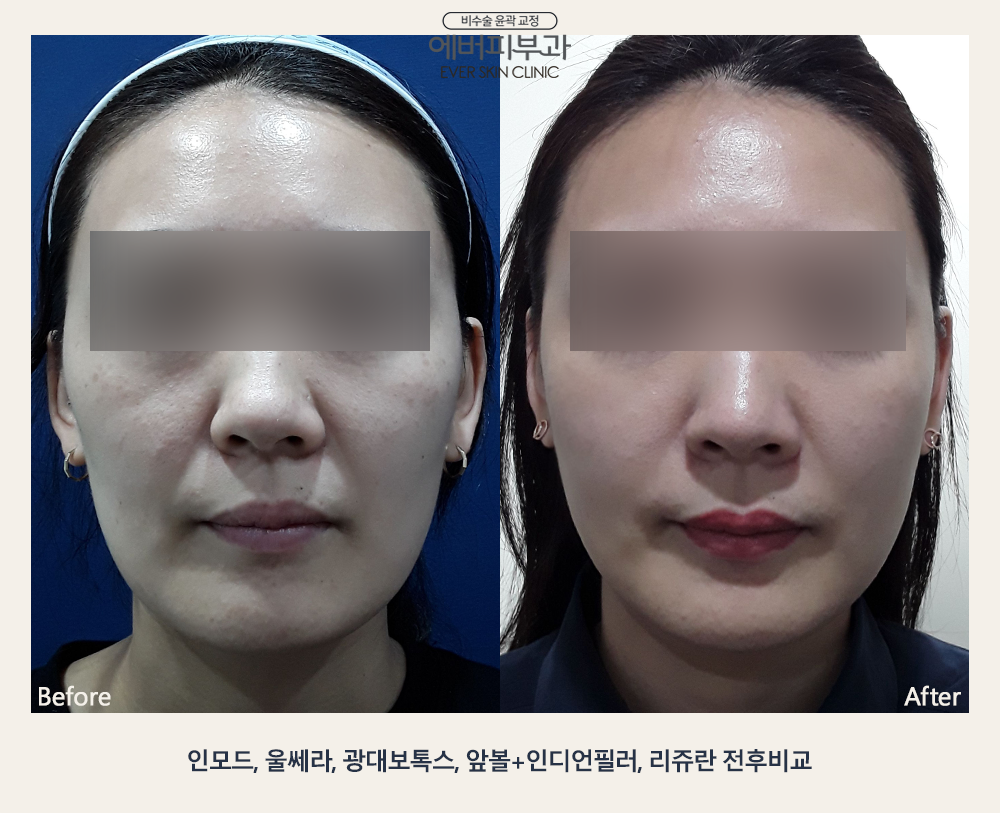
Real patient · before & after
An example of non-surgical lifting at Ever
This case shows a combined lifting, contouring and skin program and is shown as an example of our non-surgical results. It is not a XERF result.
Ask us for XERF-specific cases at consultation, where your dermatologist can explain what is realistic for your skin.
Photos are shared with the patient's consent and are not retouched apart from privacy blurring. Results differ from person to person and are not guaranteed.
See more before & after photosRecovery & safety
Recovery, side effects and aftercare
Mild redness, warmth and slight swelling are common and usually settle within hours to a day. Uncommon effects include small blisters, temporary bumps or, rarely, burns, which cooling, impedance monitoring and careful technique help prevent.
Tell your dermatologist if you have a pacemaker or implanted electronic device, metal implants in the area, are pregnant, have an active skin infection, recent fillers or threads in the treatment zone, or a history of keloids.
Aftercare tips
- Moisturise well for a few days
- Apply sunscreen daily
- Avoid saunas and very hot baths for 1 to 2 days
- Skip strong exfoliants or retinoids for a few days
- Allow 2 to 3 months to judge the full result
Questions we hear every day
XERF FAQ
Does XERF hurt?
Most patients feel heat that builds briefly with each pulse, eased by built-in cooling. Numbing cream can be used, and energy is adjustable. Tell your dermatologist if any area feels too hot.
How is XERF different from Thermage?
Both are monopolar RF. XERF uses two frequencies to reach selectable depths, so treatment can be layered for texture and firmness, while Thermage heats a broad volume of dermis. Your dermatologist will suggest which suits your skin.
How long do results last?
Results commonly last several months to around a year, depending on settings and your skin. Many patients repeat treatment periodically or combine it with HIFU for maintenance.
Can XERF be combined with other treatments?
Yes. It is often combined with focused ultrasound for deeper lift, or with skin boosters for skin quality. Your dermatologist will plan the order and timing.
Is XERF suitable before travel?
Yes. There is usually no downtime, and mild redness typically fades within a day, so it suits short stays in Seoul.
Talk to a board-certified dermatologist in Apgujeong
Send us your skin concern and photos on WhatsApp. An English-speaking team member will reply and arrange your consultation.
Mon & Thu 10:00–19:00 · Tue & Fri 10:00–20:00 · Sat 10:00–16:00 · Closed Wed, Sun & holidays