
Thread Lifting in Apgujeong,
Gangnam, Seoul
Board-Certified Dermatologist Top 2% in Korea 13+ Years
Thread Lifting · quick answer
What thread lifting does, in one paragraph
Thread lifting is a minimally invasive procedure in which dissolvable threads with small barbs or cones are placed under the skin through fine needles or cannulas to lift sagging tissue. The barbs hold tissue in a new position for a visible lift right away, and as the threads dissolve they stimulate collagen around them. It suits mild to moderate sagging of the cheeks, jowls and jawline. At Ever Skin Clinic, a board-certified dermatologist maps the lifting vectors and chooses the thread type for your face.
Medically reviewed by
Dr. Jieun Kim, M.D.
Founder & Director, Ever Skin Clinic · Board-certified dermatologist
- Adjunct Professor, Hanyang University College of Medicine
- Dermatology residency, Hanyang University Hospital
- Master’s degree in Dermatology, Hanyang University
- Regular Member, Korean Dermatological Association
- Regular Member, Korean Laser Medicine Association
- Member, World Congress of Dermatology
- Published in JAAD and Annals of Dermatology
- English-speaking consultations
Meet our dermatologists → Last reviewed October 2026
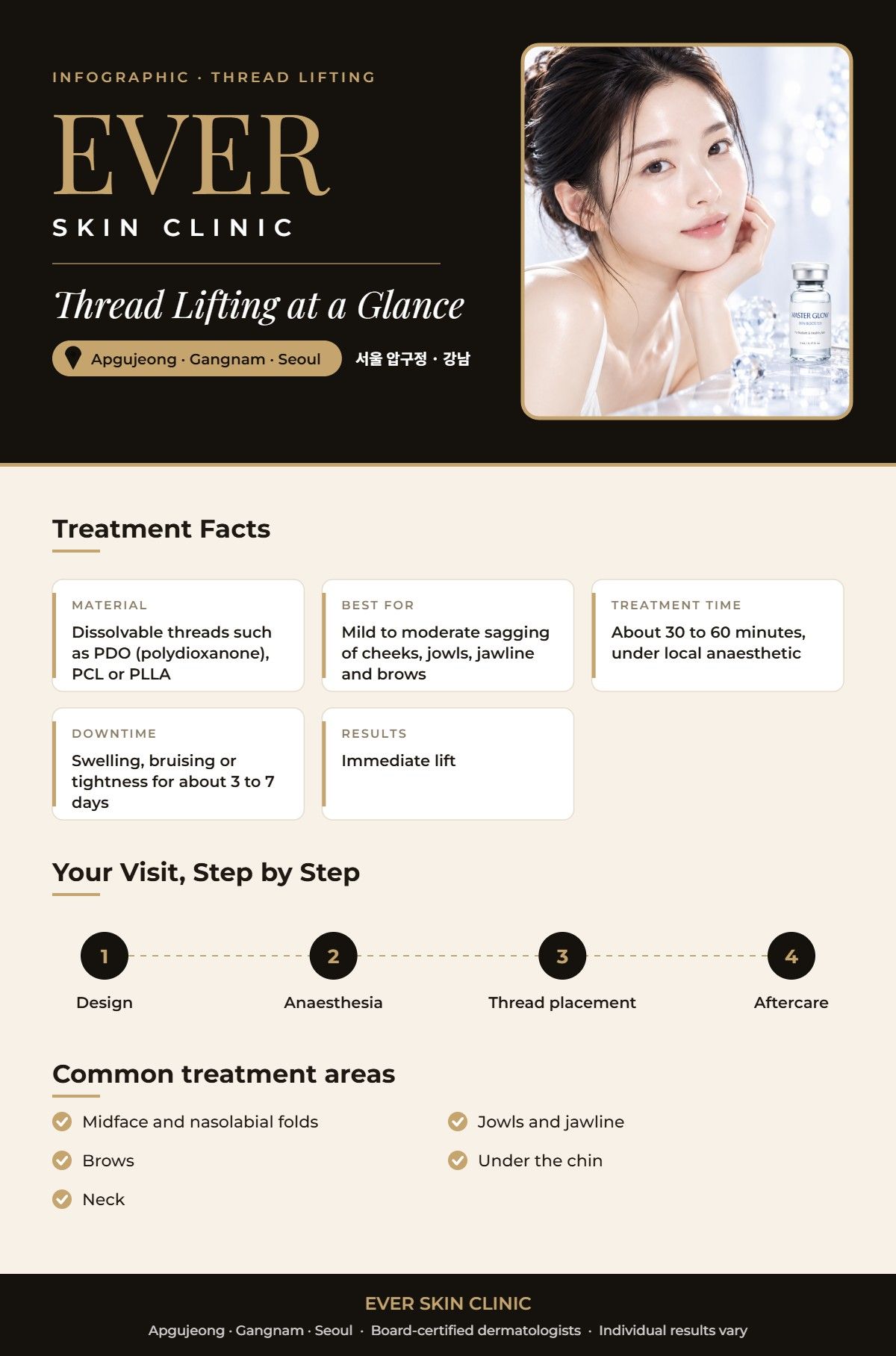
- Material
- Dissolvable threads such as PDO (polydioxanone), PCL or PLLA
- Best for
- Mild to moderate sagging of cheeks, jowls, jawline and brows
- Treatment time
- About 30 to 60 minutes, under local anaesthetic
- Downtime
- Swelling, bruising or tightness for about 3 to 7 days
- Results
- Immediate lift; commonly lasts around 1 to 2 years, varying by thread and patient
The treatment
What is thread lifting?
Unlike energy devices, which tighten tissue gradually through heat, threads give a mechanical lift: cogged threads are anchored and pulled along planned vectors so that descended tissue sits higher. Smooth threads are also placed in a mesh pattern to support skin and encourage collagen. Over the following months the threads are absorbed by the body.
The thread design matters, so our dermatologists choose between types such as MINT and PDO threads for each area. For a full overview of thread types, see our thread lifting guide.
Common treatment areas
- Midface and nasolabial folds — lifting the cheek to soften smile lines
- Jowls and jawline — a sharper lower-face contour
- Brows — a subtle eyebrow lift to open tired-looking eyes
- Under the chin — firming a double chin area
- Neck — support for mild laxity
Is it right for you?
Who is a good candidate?
Thread lifting suits people with mild to moderate sagging and reasonable skin thickness who want a more visible lift than devices alone can give, without surgery. It is often combined with HIFU or RF for tightening and with fillers where volume is lost, because threads reposition tissue but do not replace volume.
Very thin skin, heavy jowls or a lot of excess skin limit what threads can achieve, and your dermatologist will discuss alternatives in that case.
Threads may suit you if you
- Have early jowling or a softening jawline
- Want an immediate, visible lift
- Prefer local anaesthetic to surgery
- Can allow about a week for swelling to settle
- Want to combine lifting with HIFU or fillers

Your visit
What happens during thread lifting
The procedure is done in clinic under local anaesthetic and you go home the same day.
- Design Your dermatologist assesses sagging while you sit upright and marks entry points and lifting vectors.
- Anaesthesia Numbing cream and local anaesthetic are applied at the entry points and along the thread paths.
- Thread placement Threads are inserted through fine needles or cannulas, anchored and gently adjusted for symmetry, usually in about 30 to 60 minutes.
- Aftercare We check the result, explain aftercare and can review you after about 1 to 2 weeks if your stay allows.
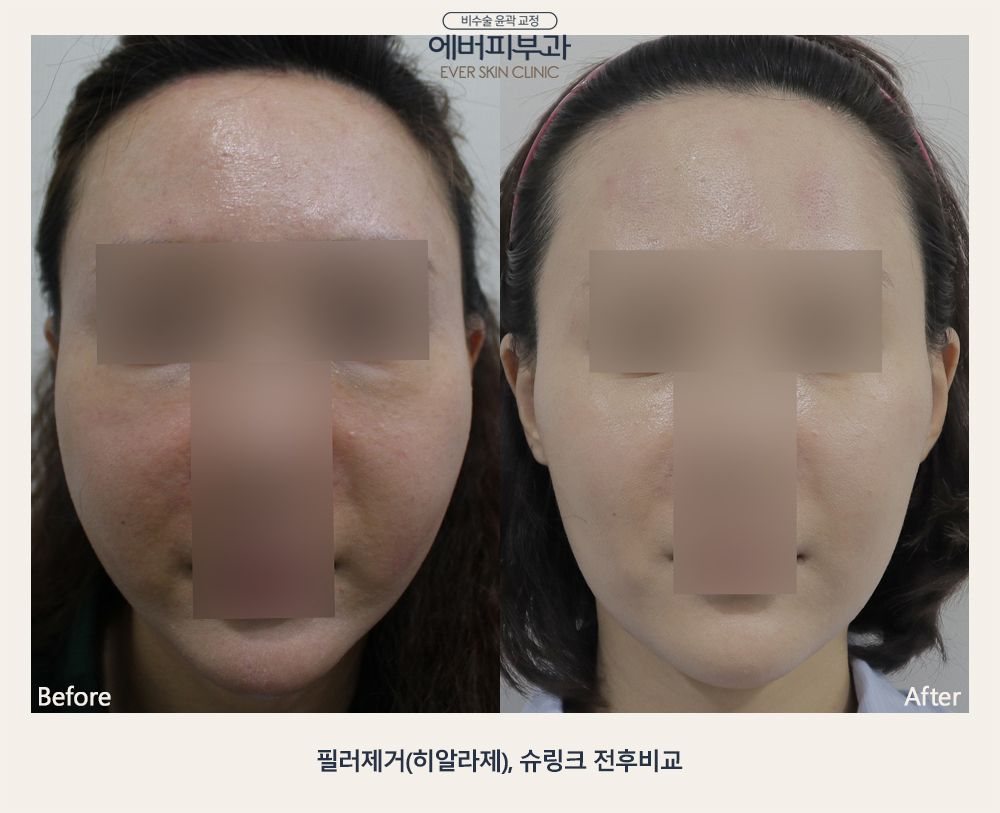
Real patient · before & after
An example of our non-surgical lifting results
This case shows a patient treated with hyaluronidase to dissolve previous filler followed by Shurink HIFU lifting. It is shown as an example of non-surgical lifting at our clinic; no threads were used.
Thread lift results depend on thread type, anatomy and skin quality. Ask us for thread-specific cases at consultation.
Photos are shared with the patient's consent and are not retouched apart from privacy blurring. Results differ from person to person and are not guaranteed.
See more before & after photosRecovery & safety
Recovery, side effects and aftercare
Swelling, bruising, tenderness and a pulling sensation are common for about three to seven days, and small dimples at entry points usually settle within one to two weeks. Less common problems include asymmetry, a palpable or visible thread, infection or prolonged pain; these can usually be managed, and threads can be removed or corrected if needed.
Tell your dermatologist if you take blood thinners, have a bleeding disorder, an active skin infection, an autoimmune condition, keloid tendency, previous threads or permanent fillers in the area, or if you are pregnant or breastfeeding.
Aftercare tips
- Avoid wide mouth opening, chewing hard food and dental work for about 2 weeks
- Sleep on your back with your head raised for the first few nights
- Do not massage or rub the face for about 2 to 4 weeks
- Skip saunas, intense exercise and alcohol for about a week
- Contact the clinic if pain, redness or swelling increases rather than settles
Questions we hear every day
Thread Lifting FAQ
Does thread lifting hurt?
Local anaesthetic is used along the thread paths, so most patients feel pressure and pulling rather than sharp pain. The face may feel sore or tight for several days afterwards, which simple painkillers usually manage. Let your dermatologist know if you are anxious about pain.
How long does a thread lift last?
The visible lift commonly lasts around one to two years, although threads themselves dissolve sooner. Longevity depends on thread type, the number used, skin quality and how quickly your face ages. Many patients repeat threads or combine them with device lifting for maintenance.
How soon can I fly after a thread lift?
Flying is generally fine within a day or two, but swelling and bruising can last up to about a week. If possible, allow a few days in Seoul so your dermatologist can check you before you leave, and avoid heavy lifting of luggage straight after treatment.
Threads or HIFU: which is better for me?
They work differently. HIFU tightens gradually through heat with little downtime, while threads physically reposition tissue for a more visible immediate lift with a few days of swelling. Many patients benefit from both, and your dermatologist will recommend based on the degree of sagging.
Can threads be removed if I am unhappy?
In many cases, yes. Threads that are visible, palpable or causing irregularity can often be trimmed or removed, particularly in the first weeks, and many minor dimples settle on their own. See our revision thread lifting page for how we assess previous thread procedures.
Talk to a board-certified dermatologist in Apgujeong
Send us your skin concern and photos on WhatsApp.
An English-speaking team member will reply and arrange your consultation.
Mon & Thu 10:00–19:00 · Tue & Fri 10:00–20:00 · Sat 10:00–16:00 · Closed Wed, Sun & holidays

