
PDO Thread Lift in Apgujeong, Gangnam Seoul
Board-Certified Dermatologist Top 2% in Korea 13+ Years
PDO Thread Lift · quick answer
What a PDO thread lift does, in one paragraph
A PDO thread lift places fine dissolvable threads of polydioxanone (PDO) under the skin with a needle or cannula. Barbed threads give a mechanical lift, while smooth threads placed in a mesh mainly tighten and thicken the skin by stimulating collagen around them as they dissolve over about six to eight months. It is used for mild sagging and loss of firmness on the jawline, cheeks and neck. At Ever Skin Clinic, a board-certified dermatologist chooses the thread types and pattern for your skin.
Medically reviewed by Dr. Jieun Kim, M.D. Founder & Director, board-certified dermatologist. Dermatology residency at Hanyang University Hospital; adjunct professor, Hanyang University College of Medicine. Meet our dermatologists Last reviewed October 2026
- Material
- Polydioxanone (PDO), absorbable
- Best for
- Mild laxity, crepey skin, early jowls, neck firmness
- Treatment time
- About 30 to 60 minutes including numbing
- Downtime
- Swelling and bruising for about 3 to 7 days
- Results
- Immediate lift from barbed threads; collagen firming over 2 to 3 months
The treatment
What is a PDO thread lift?
PDO has been used as an absorbable surgical suture for decades. In skin tightening, threads act as a scaffold: the body forms new collagen around them, so the skin becomes firmer even after the threads have dissolved. Smooth mono threads are mainly for tightening and texture, while barbed threads lift tissue.
This page focuses on PDO threads for tightening and firmness. For stronger lifting with moulded-barb threads, see PDO and MINT threads, or the thread lifting overview.
What PDO threads can help
- Crepey skin on the cheeks and lower face
- Early jowls and a softening jawline
- Neck laxity and horizontal neck lines
- Mild midface sagging with barbed threads
- Maintenance alongside energy-based tightening
Is it right for you?
Who is a good candidate?
PDO thread lifts suit adults with mild sagging and loss of firmness who want visible improvement without surgery. Patients with heavy sagging or very thin, fragile skin may get limited benefit or a higher chance of visible threads, and your dermatologist will discuss alternatives such as HIFU.
A PDO thread lift may suit you if you
- Have early laxity on the jawline or neck
- Want firmer, thicker-feeling skin
- Prefer a minimally invasive option to surgery
- Can allow about a week for swelling to settle
- Want to combine tightening with fillers or devices
Your visit
What happens during treatment
A typical session takes about 30 to 60 minutes, and you go home the same day.
- Consultation A board-certified dermatologist assesses laxity and skin thickness and agrees thread types and areas with you.
- Numbing Numbing cream and local anaesthetic are applied at entry points.
- Thread placement Threads are inserted with fine needles or cannulas in a planned pattern, and barbed threads are gently anchored.
- Aftercare We check the result, explain aftercare and advise on follow-up.
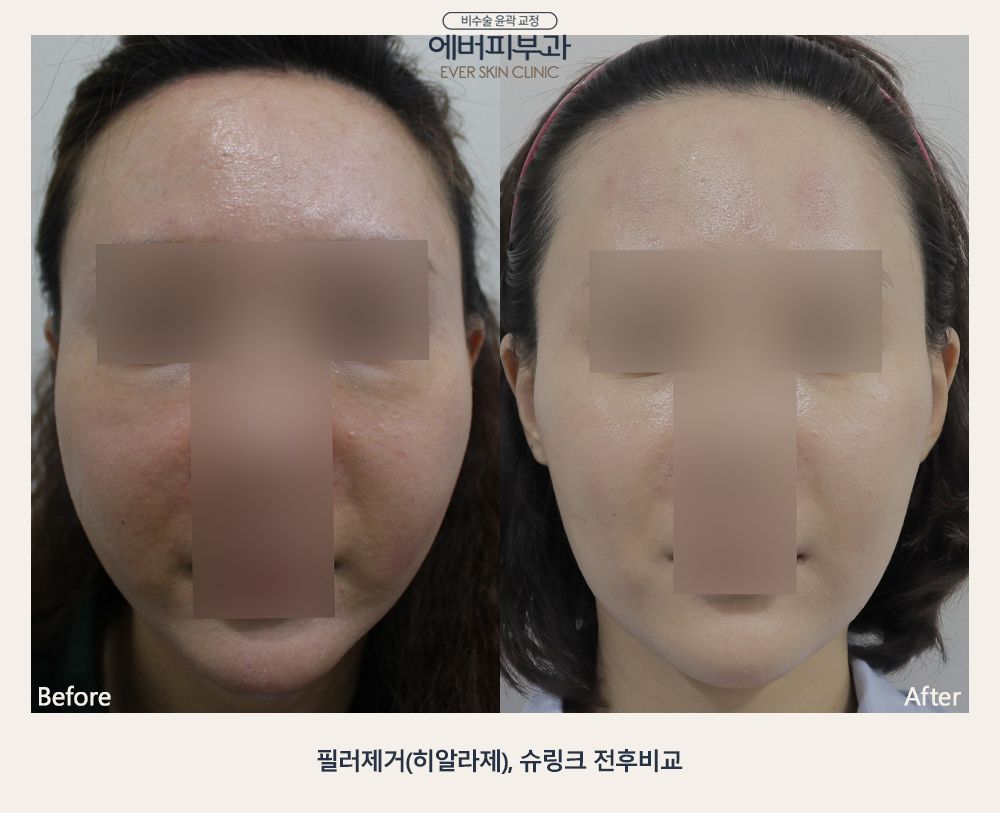
Real patient · before & after
An example of non-surgical tightening
This case shows filler dissolving followed by Shurink focused-ultrasound lifting, shown as an example of our non-surgical tightening results. It does not include threads, so it is not a PDO thread lift result.
Ask us for thread lift cases at consultation to see realistic outcomes.
Photos are shared with the patient's consent and are not retouched apart from privacy blurring. Results differ from person to person and are not guaranteed.
See more before & after photosRecovery & safety
Recovery, side effects and aftercare
Swelling, bruising, tenderness and mild tightness are common for about three to seven days. Small dimples or irregularities can appear and usually settle within one to two weeks. Less common risks include visible or palpable threads, asymmetry, infection or thread extrusion, which can be managed if they occur.
Tell your dermatologist if you take blood thinners, have an autoimmune disorder, keloid tendency, active skin infection, or are pregnant or breastfeeding.
Aftercare tips
- Avoid wide mouth opening and hard chewing for about a week
- Sleep on your back with your head slightly raised
- Avoid facial massage and facials for about 2 to 4 weeks
- Skip saunas, alcohol and intense exercise for about a week
- Contact the clinic if you notice increasing pain, redness or a thread end
Questions we hear every day
PDO Thread Lift FAQ
Does a PDO thread lift hurt?
Local anaesthetic makes the procedure tolerable for most patients, who feel pressure and some pulling. Soreness and tightness are common for several days afterwards and usually ease within one to two weeks.
How long do PDO thread results last?
PDO threads dissolve over about six to eight months, but the collagen they stimulate can keep skin firmer for longer. Many patients see effects for around six to twelve months. Results vary with skin and lifestyle.
What is the difference between this and MINT threads?
Both are PDO. This page covers PDO threads mainly for tightening and mild lift, including smooth threads. MINT threads have moulded barbs for stronger lifting of heavier tissue. Your dermatologist may combine both.
Can PDO threads be combined with other treatments?
Yes. Threads are often combined with radiofrequency or ultrasound tightening and with fillers. Your dermatologist will plan the order, as some devices are best done before threads are placed.
Can I fly home after a PDO thread lift?
Most patients can fly after a few days. We recommend avoiding a flight on the same day and allowing about a week for swelling and irregularities to settle, ideally with a review before you leave.
Talk to a board-certified dermatologist in Apgujeong
Send us your skin concern and photos on WhatsApp. An English-speaking team member will reply and arrange your consultation.
Mon & Thu 10:00–19:00 · Tue & Fri 10:00–20:00 · Sat 10:00–16:00 · Closed Wed, Sun & holidays