
Hair & Scalp Treatments in Apgujeong,
Gangnam, Seoul
Board-Certified Dermatologist Top 2% in Korea 13+ Years
Hair & Scalp Treatments · quick answer
How we approach hair loss, in one paragraph
Hair and scalp care at Ever Skin Clinic starts with a dermatologist's diagnosis, because thinning hair has many causes, from pattern hair loss and stress shedding to scalp inflammation or thyroid and iron problems. Treatment is then built in layers: proven medication such as minoxidil or finasteride where suitable, regenerative scalp injections such as PRP or exosomes, and supportive laser or scalp care. Our board-certified dermatologists in Apgujeong explain which options fit your pattern, stage and travel plans.
Medically reviewed by
Dr. Jieun Kim, M.D.
Founder & Director, Ever Skin Clinic · Board-certified dermatologist
- Adjunct Professor, Hanyang University College of Medicine
- Dermatology residency, Hanyang University Hospital
- Master’s degree in Dermatology, Hanyang University
- Regular Member, Korean Dermatological Association
- Regular Member, Korean Laser Medicine Association
- Member, World Congress of Dermatology
- Published in JAAD and Annals of Dermatology
- English-speaking consultations
Meet our dermatologists → Last reviewed October 2026
- Conditions
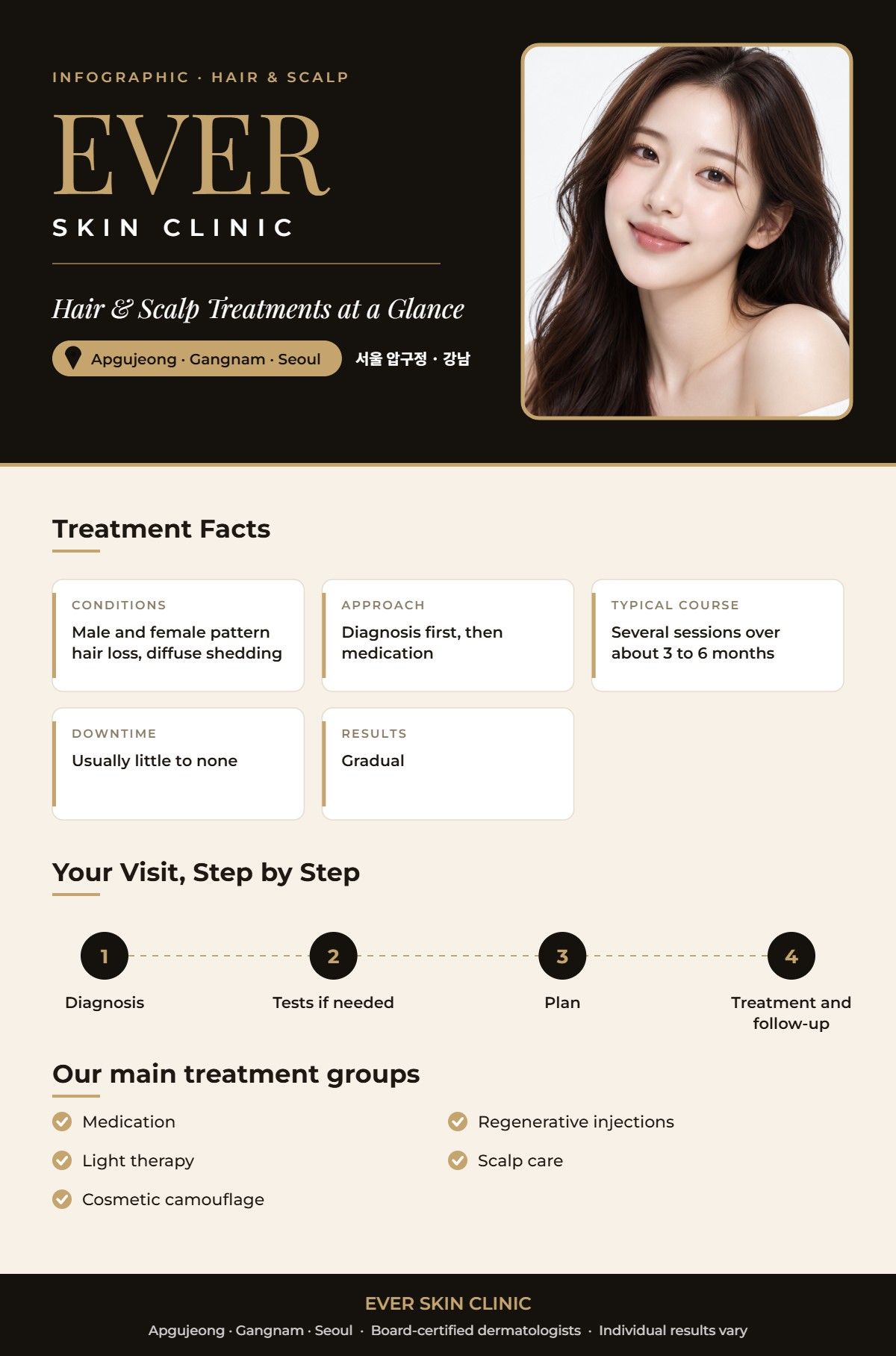
- Male and female pattern hair loss, diffuse shedding, scalp inflammation
- Approach
- Diagnosis first, then medication, regenerative injections and laser care
- Typical course
- Several sessions over about 3 to 6 months
- Downtime
- Usually little to none; mild scalp tenderness after injections
- Results
- Gradual; hair cycles mean changes take about 3 to 6 months
Hair & scalp care
What we treat and how
Most thinning in adults is androgenetic (pattern) hair loss, in which follicles gradually shrink under the influence of DHT. Other common causes include telogen effluvium (shedding after illness, childbirth, stress or dieting), alopecia areata, and scalp conditions such as seborrhoeic dermatitis. Each needs a different plan, which is why we start with a scalp examination and history and, where useful, blood tests.
Our options range from medical therapy with proven medications to regenerative hair loss treatment such as PRP, exosomes and M-Cure Cell, plus laser scalp therapy as support.
Our main treatment groups
- Medication : minoxidil and, for suitable patients, finasteride or dutasteride
- Regenerative injections : PRP, exosomes and M-Cure Cell for the scalp
- Light therapy : low-level laser to support follicle activity
- Scalp care : treatment of inflammation, dandruff and sensitivity
- Cosmetic camouflage : scalp micropigmentation for the look of density
Who we help
Who our hair and scalp program suits
Treatment works best while follicles are still alive, so early to moderate thinning responds better than long-standing bald areas. Both men and women are treated, and the plan differs: some medications are not suitable for women who may become pregnant.
Many of our patients are international visitors. We can start a plan during your stay and advise how to continue medication at home with your own doctor.
You may benefit if you
- Notice a widening part, receding hairline or thinning crown
- Are shedding more than usual after illness, childbirth or stress
- Have an itchy, flaky or inflamed scalp alongside thinning
- Want a non-surgical plan or support after a hair transplant
- Are visiting Seoul and want a dermatologist's diagnosis

Your visit
How a hair and scalp visit works
A first visit usually takes about an hour, including assessment and, if you choose, a first treatment.
- Diagnosis A board-certified dermatologist reviews your history and examines the scalp and hair, using magnification to check follicle size and scalp health.
- Tests if needed Blood tests such as iron or thyroid levels may be suggested when shedding could have an internal cause.
- Plan We agree a combination of medication, injections or laser care that fits your pattern, budget of time and travel plans.
- Treatment and follow-up Treatments can often start the same day, with progress photos to compare at follow-up visits.
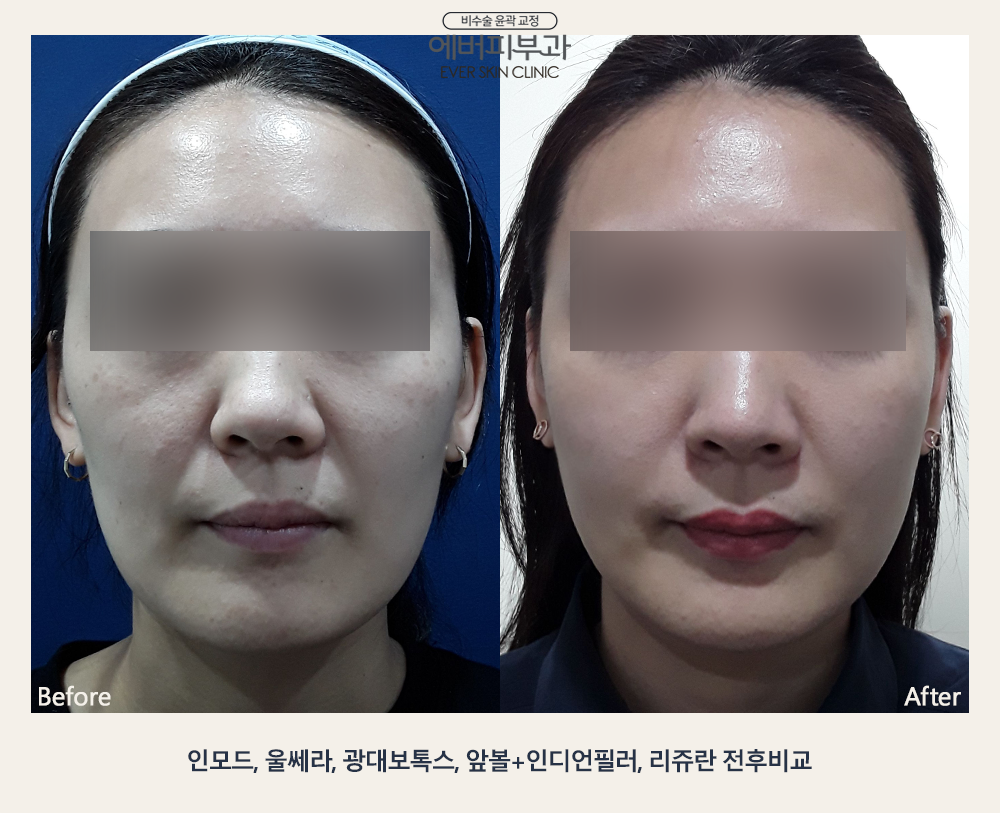
Real patient · before & after
About our before-and-after photos
This case shows a combined facial lifting and skin program, shared as an example of our non-surgical work. It is not a hair or scalp result.
Hair results are best judged with standardised scalp photos over several months. Ask us at consultation to see hair-specific progress examples and to set up your own baseline photos.
Photos are shared with the patient's consent and are not retouched apart from privacy blurring. Results differ from person to person and are not guaranteed.
See more before & after photosSafety & practical info
Safety, side effects and practical points
Most hair treatments have little downtime. Scalp injections can cause brief soreness, small bruises or mild swelling, and medications have specific side effects that your dermatologist will explain before you start. A temporary increase in shedding can occur in the first weeks of some treatments as resting hairs are replaced.
Tell your dermatologist if you are pregnant, planning pregnancy or breastfeeding, take blood thinners, have a bleeding disorder, heart or blood pressure problems, or an active scalp infection.
Aftercare tips
- Keep progress photos in the same light every month
- Avoid washing the hair for the rest of the day after injections
- Skip saunas and intense exercise for about 24 hours after injections
- Continue prescribed medication daily; stopping usually reverses the gains
- Use a gentle shampoo and treat any scalp inflammation
Questions we hear every day
Hair & Scalp Treatments FAQ
What causes hair loss in adults?
The most common cause is pattern hair loss, which is inherited and driven by DHT. Others include shedding after illness, childbirth or stress, iron or thyroid problems, alopecia areata and scalp inflammation. Because treatments differ, a dermatologist's diagnosis is the first step before choosing any therapy.
How long before I see results?
Hair grows in slow cycles, so most treatments take about three to six months to show visible change, and up to a year for the full effect. Early signs are often less shedding rather than new hair. Monthly photos make progress easier to judge.
Can hair loss treatment be done during a short trip to Seoul?
Yes. A diagnosis, a first PRP or exosome session and a medication plan can usually be done in one visit. Ongoing medication can be continued at home, and we can provide a written summary for your own doctor.
Do I have to keep treatment forever?
Pattern hair loss is progressive, so gains from medication usually fade within months of stopping. Regenerative injections typically need maintenance every few months to a year. Your dermatologist will help you find the simplest plan you can sustain.
Is hair loss treatment suitable for women?
Yes. Women often have diffuse thinning and respond to minoxidil, PRP and scalp care. Some medications, such as finasteride and dutasteride, are generally avoided in women who could become pregnant, so plans for women are chosen carefully.
Talk to a board-certified dermatologist in Apgujeong
Send us your skin concern and photos on WhatsApp.
An English-speaking team member will reply and arrange your consultation.
Mon & Thu 10:00–19:00 · Tue & Fri 10:00–20:00 · Sat 10:00–16:00 · Closed Wed, Sun & holidays