
Facial Fat Grafting in Apgujeong, Gangnam Seoul
Board-Certified Dermatologist Top 2% in Korea 13+ Years
Facial Fat Grafting · quick answer
What facial fat grafting does, in one paragraph
Facial fat grafting, also called autologous fat transfer, moves a small amount of your own fat from an area such as the abdomen or thigh to parts of the face that have lost volume. The fat is harvested with a fine cannula, purified and injected in tiny amounts into areas such as the cheeks, temples or under-eyes. Part of the transferred fat survives long term. At Ever Skin Clinic, a board-certified dermatologist first assesses whether fat, filler or a collagen stimulator best suits your face.
Medically reviewed by Dr. Jieun Kim, M.D. Founder & Director, board-certified dermatologist. Dermatology residency at Hanyang University Hospital; adjunct professor, Hanyang University College of Medicine. Meet our dermatologists Last reviewed October 2026
- Material
- Your own purified fat (autologous)
- Best for
- Hollow cheeks, temples and under-eyes; volume loss after ageing or weight loss
- Procedure time
- Typically about 1 to 2 hours, under local anaesthesia
- Downtime
- Swelling and bruising, usually about 1 to 2 weeks
- Results
- Final result after about 3 months; surviving fat is long-lasting, but some is reabsorbed
The treatment
What is facial fat grafting?
Fat grafting uses your own tissue as a natural volumiser. A small volume of fat is gently suctioned from a donor area, processed to remove fluid and damaged cells, and then placed in very small droplets in layers of the face. Grafted fat needs a new blood supply to survive, so a proportion is naturally reabsorbed in the first months; the fat that remains behaves like your own tissue.
Because it is a minor surgical procedure with a longer recovery than injectables, our dermatologists compare it with hyaluronic acid fillers and collagen stimulators before recommending it.
Fat grafting compared with fillers
- Material: your own fat versus a manufactured gel
- Longevity: surviving fat can last for years; HA fillers typically last months to about two years
- Predictability: fat survival varies, so a top-up session is sometimes needed; fillers are more precise
- Reversibility: HA filler can be dissolved; fat cannot
- Recovery: fat grafting involves a donor site and more swelling
Is it right for you?
Who is a good candidate?
Good candidates are healthy adults with clear volume loss across larger areas, such as flat cheeks or hollow temples, who have enough donor fat and can allow for a week or two of visible swelling. It is less suitable for fine-tuning small areas, where filler is more precise.
Patients who need lifting rather than volume may be better served by non-surgical lifting, and your dermatologist will explain the difference honestly.
Fat grafting may suit you if you
- Have hollow cheeks or temples from ageing or weight loss
- Want longer-lasting volume and accept a longer recovery
- Have enough fat in the abdomen or thighs to harvest
- Have a stable weight, since fat cells change with weight
- Prefer using your own tissue rather than a filler product
Your visit
What happens during treatment
The procedure usually takes about one to two hours and is done under local anaesthesia, sometimes with light sedation.
- Consultation A board-certified dermatologist assesses your facial volume, skin and donor areas and agrees the plan and expected recovery with you.
- Harvesting After local anaesthesia, a small amount of fat is suctioned from the donor area through a tiny incision with a fine cannula.
- Processing and injection The fat is purified and injected in small amounts into the planned areas with a blunt microcannula.
- Follow-up We explain aftercare and review you as swelling settles, discussing a top-up only if needed after about 3 months.
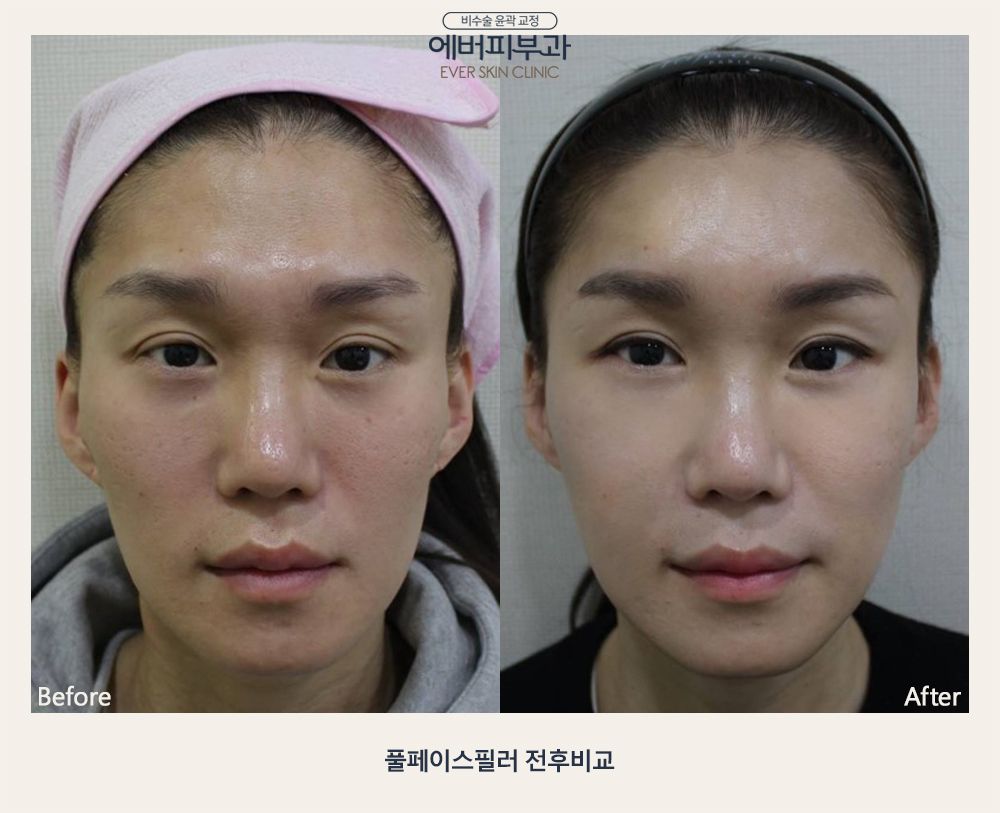
Real patient · before & after
Restoring facial volume: a filler example
This case shows a full-face filler treatment, included as an example of how our dermatologists restore balanced volume. It is not a fat grafting result.
Fat grafting aims for a similar softer, fuller look but with a different recovery and longevity. Ask us at consultation which approach suits your face and travel plans.
Photos are shared with the patient's consent and are not retouched apart from privacy blurring. Results differ from person to person and are not guaranteed.
See more before & after photosRecovery & safety
Recovery, side effects and aftercare
Swelling and bruising in the face and donor area are expected and usually settle over one to two weeks, though some swelling can take longer. Possible risks include uneven results, lumps, infection, over- or under-correction and, rarely, fat entering a blood vessel, which is why blunt cannulas and careful technique are used.
Tell your dermatologist if you take blood thinners or supplements that increase bleeding, smoke, have a bleeding disorder, diabetes or an active infection, or are pregnant or breastfeeding. International patients should plan to stay in Seoul for at least about a week after treatment.
Aftercare tips
- Sleep with your head raised for the first few nights
- Use cold compresses on the first day, then avoid heat
- Do not press or massage the grafted areas
- Avoid smoking and alcohol, which can reduce fat survival
- Wear any compression garment on the donor site as advised
Questions we hear every day
Facial Fat Grafting FAQ
Is facial fat grafting painful?
The harvest and injection areas are numbed with local anaesthesia, so most patients feel pressure rather than sharp pain during treatment. Soreness, tightness and bruising are common for several days afterwards and are usually managed with simple pain relief advised by your doctor.
How long does fat grafting last?
Some of the transferred fat is reabsorbed in the first two to three months. The fat that survives after that point is generally long-lasting, although it still ages with you and can change with weight gain or loss. Survival varies between individuals.
Will I need more than one session?
Many patients need only one session, but because fat survival is not fully predictable, a smaller top-up is sometimes recommended after about three months. Your dermatologist will discuss this possibility before you decide.
Is fat grafting better than filler?
Neither is better for everyone. Fat can last longer and uses your own tissue, while filler is more precise, has less downtime and hyaluronic acid filler can be dissolved. Your dermatologist will compare both for your face and goals.
Can I have fat grafting during a short trip to Seoul?
It is possible, but plan for visible swelling and bruising for about one to two weeks and avoid flying on the same day. We recommend staying in Seoul for at least about a week for review, so injectables may suit shorter trips better.
Talk to a board-certified dermatologist in Apgujeong
Send us your skin concern and photos on WhatsApp. An English-speaking team member will reply and arrange your consultation.
Mon & Thu 10:00–19:00 · Tue & Fri 10:00–20:00 · Sat 10:00–16:00 · Closed Wed, Sun & holidays