
Korean-Style Fillers in Apgujeong,
Gangnam, Seoul
Board-Certified Dermatologist Top 2% in Korea 13+ Years
Korean-Style Fillers · quick answer
What Korean-style filler means, in one paragraph
Korean-style filler is not a product but an approach: small amounts of hyaluronic acid (HA) filler placed across several areas, such as the forehead, temples, front cheeks, nose and chin, to create soft, smooth contours and a balanced, slimmer-looking face rather than obvious volume in one spot. It often pairs with Botox and skin boosters. At Ever Skin Clinic in Apgujeong, a board-certified dermatologist analyses your proportions first and plans the minimum filler needed for a natural result.
Medically reviewed by
Dr. Jieun Kim, M.D.
Founder & Director, Ever Skin Clinic · Board-certified dermatologist
- Adjunct Professor, Hanyang University College of Medicine
- Dermatology residency, Hanyang University Hospital
- Master’s degree in Dermatology, Hanyang University
- Regular Member, Korean Dermatological Association
- Regular Member, Korean Laser Medicine Association
- Member, World Congress of Dermatology
- Published in JAAD and Annals of Dermatology
- English-speaking consultations
Meet our dermatologists → Last reviewed October 2026
- Approach
- Whole-face planning with small, layered HA amounts
- Common areas
- Forehead, temples, front cheeks, nose, chin, jawline
- Treatment time
- About 30 to 60 minutes, depending on areas
- Downtime
- Mild swelling or bruising for a few days
- Duration
- Often around 6 to 18 months, by product and area
The approach
What are Korean-style fillers?
In Korean aesthetic dermatology, filler is used to smooth the transitions of the face: a rounded forehead flowing into full temples, soft front cheeks, a straight nose bridge and a slightly projected chin. Each area gets only a modest amount, so the overall face looks refined and youthful rather than filled. The same thinking explains why wide cheekbones are often softened by filling the temples and hollows around them instead of adding more volume to the cheek.
Plans often include temple filler, front cheek filler and chin filler, combined with non-surgical facial contouring using Botox where muscle bulk is the issue.
Principles we follow
- Balance over volume — proportions of the whole face guide each area
- Minimum effective amount — small layered doses rather than one large bolus
- Right product, right layer — firmer HA for structure, softer HA for delicate areas
- Contour and skin together — boosters or lifting where skin quality or laxity matters
- Reversible first — HA fillers can be dissolved if needed
Is it right for you?
Who is a good candidate?
This approach suits people who want a soft, natural refinement rather than a dramatic change, including first-time filler patients and international visitors who like the smooth, youthful Korean look. It also suits patients with hollow temples, a flat forehead or a weak chin that make the face look angular or tired.
Your dermatologist will check your skin, bone structure and any previous filler. If old filler has migrated or looks heavy, dissolving it first may give a better base.
Korean-style filler may suit you if you
- Prefer subtle, balanced enhancement
- Have hollow temples, a flat forehead or a weak chin
- Want a slimmer-looking V-line without surgery
- Feel past filler made your face look heavy
- Want to combine contour with better skin quality

Your visit
What happens during treatment
Because several areas may be treated, allow about an hour or a little more in clinic.
- Facial analysis Your dermatologist assesses proportions from the front and side and agrees which areas to treat and in what order.
- Numbing Numbing cream is applied, with local anaesthetic where helpful.
- Layered injection Small amounts of suitable HA are placed by cannula or needle, area by area, checking balance throughout.
- Review We review the whole face upright, explain aftercare and suggest a check at about two weeks.
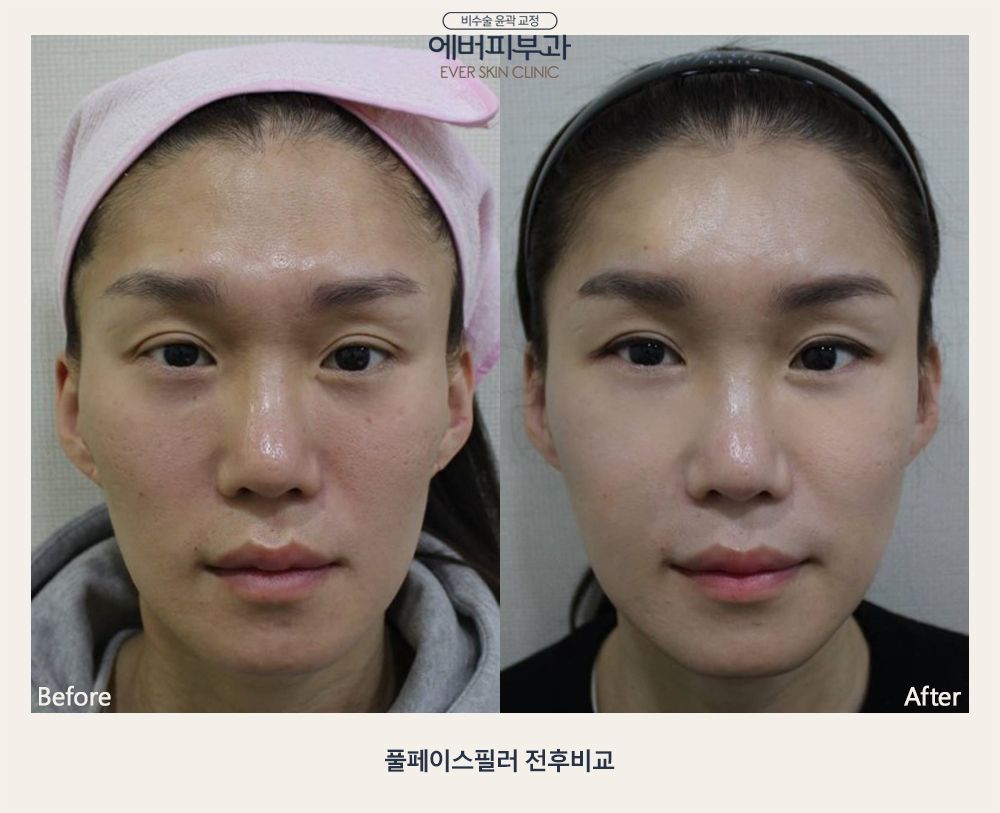
Real patient · before & after
Balanced volume across the whole face
This patient received filler in several areas as one plan. The contours look smoother and more connected, without a single area looking obviously filled.
The areas and amounts differ for every face, so your dermatologist will explain which areas would make the most difference for you and which are better left alone.
Photos are shared with the patient's consent and are not retouched apart from privacy blurring. Results differ from person to person and are not guaranteed.
See more before & after photosRecovery & safety
Recovery, side effects and aftercare
Expect mild swelling, tenderness and possibly small bruises for a few days, more when several areas are treated. Most people return to normal activities quickly. Lumps or asymmetry are uncommon and usually correctable, and HA can be dissolved with hyaluronidase. Vascular occlusion is rare but serious and needs immediate treatment.
Tell your dermatologist about previous fillers, threads or surgery, allergies, autoimmune conditions, blood thinners or supplements, and pregnancy or breastfeeding. Contact the clinic urgently for increasing pain, blanching, skin colour or vision changes.
Aftercare tips
- Avoid pressing or massaging treated areas unless advised
- Skip saunas, hot baths and intense exercise for 2 to 3 days
- Limit alcohol for a couple of days
- Sleep on your back for the first few nights if possible
- Wait about two weeks before judging the overall result
Questions we hear every day
Korean-Style Fillers FAQ
Is Korean-style filler a special product?
No. It refers to the planning style rather than a brand. We use licensed HA fillers, including international and Korean products, and choose firmness by area. Your dermatologist will explain the options available at your visit.
Does it hurt?
Most patients feel pressure and brief stinging. Numbing cream is used, and many fillers contain lidocaine. Treating several areas takes longer, so tell your dermatologist if you need breaks or extra numbing.
How long do results last?
Depending on the product and area, HA filler often lasts around six to eighteen months, with firmer structural fillers in low-movement areas tending to last longer. Many patients maintain results with smaller top-ups.
Will I look overfilled?
The aim is the opposite. Korean-style planning uses small amounts across several areas so no single area looks heavy. If you already have filler, your dermatologist may recommend less, or dissolving some first.
Can I have several areas treated during a short trip?
Usually yes. Swelling from multiple areas tends to settle over a few days, and flying is generally fine. If possible, schedule treatment early in your trip so a review can be done before you leave.
Talk to a board-certified dermatologist in Apgujeong
Send us your skin concern and photos on WhatsApp.
An English-speaking team member will reply and arrange your consultation.
Mon & Thu 10:00–19:00 · Tue & Fri 10:00–20:00 · Sat 10:00–16:00 · Closed Wed, Sun & holidays

