
Radiesse Fillers in Apgujeong, Gangnam Seoul
Board-Certified Dermatologist Top 2% in Korea 13+ Years
Radiesse Fillers · quick answer
What Radiesse filler does, in one paragraph
Radiesse is an injectable filler made of calcium hydroxylapatite (CaHA) microspheres suspended in a gel. Placed deep under the skin or on the bone, it adds firm structural support straight away, and as the gel is absorbed the microspheres encourage your own collagen to form around them. It is used mainly to define the jawline and chin, support the cheeks, soften deeper folds and refresh thin hands. At Ever Skin Clinic, a board-certified dermatologist decides area by area whether Radiesse or a hyaluronic acid filler is the safer, better fit.
Medically reviewed by Dr. Jieun Kim, M.D. Founder & Director, board-certified dermatologist. Dermatology residency at Hanyang University Hospital; adjunct professor, Hanyang University College of Medicine. Meet our dermatologists Last reviewed October 2026
- Ingredient
- Calcium hydroxylapatite (CaHA) microspheres in a gel carrier
- Best for
- Jawline, chin, cheeks, deeper folds, back of the hands
- Treatment time
- About 30 minutes including numbing
- Downtime
- Swelling or bruising for a few days in some patients
- Duration
- Often around 12 to 18 months, varying by area and person
The filler
What is Radiesse and where is it used?
Radiesse is a so-called biostimulatory filler. Unlike a hyaluronic acid (HA) filler, which mainly holds water to add soft volume, Radiesse is firmer and gives a lifting, structural effect. Over the following months the carrier gel is absorbed and the CaHA microspheres act as a scaffold that prompts collagen production, before they are gradually broken down by the body.
On this page we focus on Radiesse as a contouring filler by area. For its use as a diluted collagen stimulator for skin firmness, see our Radiesse collagen-stimulator page, and for a side-by-side view of similar products, our Sculptra and Radiesse comparison.
Areas where Radiesse is commonly used
- Jawline and chin — firm support for a more defined lower face
- Cheeks and midface — structural lift where volume has flattened
- Nasolabial folds and marionette lines — deeper creases rather than fine lines
- Back of the hands — softening visible tendons and veins
- Not used in lips or under the eyes, where a soft, reversible HA filler is safer
Is it right for you?
Who is a good candidate for Radiesse?
Radiesse suits adults who want firm, longer-lasting support in areas with good soft-tissue cover, such as the jaw, chin and cheeks. It is often chosen by patients whose skin is beginning to thin and lose firmness as well as volume.
An important difference is that Radiesse cannot be dissolved with hyaluronidase the way HA fillers can. For a first-time filler patient, or for delicate areas, your dermatologist may recommend starting with HA, or combining both in one plan.
Radiesse may suit you if you want to
- Define a soft jawline or a short, recessed chin
- Restore cheek support that has flattened with age
- Soften deeper folds as part of a full-face plan
- Refresh thin hands with visible tendons
- Have fewer top-up visits than with many HA fillers
Your visit
What happens during treatment
Most Radiesse appointments take about 30 to 45 minutes, so it can be done during a short stay in Seoul.
- Consultation A board-certified dermatologist assesses your face or hands, explains HA versus Radiesse for each area and agrees the plan with you.
- Preparation The skin is cleansed and marked; Radiesse is usually mixed with lidocaine and numbing cream may be applied.
- Injection The filler is placed at the planned depth with a fine cannula or needle, then gently shaped.
- Review We check symmetry, explain aftercare and arrange follow-up by message if you are travelling.
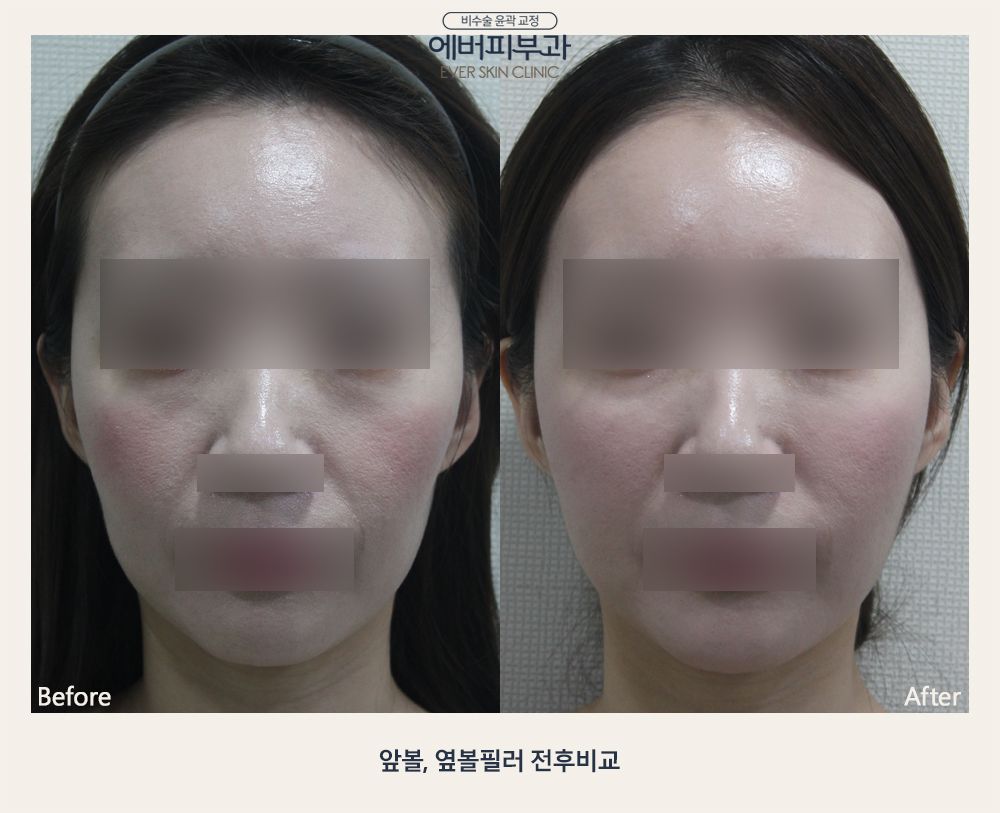
Real patient · before & after
Midface support with filler
This patient received front-cheek and side-cheek filler to restore a smoother, more supported midface. It is shown as an example of how our dermatologists shape the cheeks with filler; the photo is not a Radiesse result.
Whether Radiesse, an HA filler or a combination is best depends on your skin, the area and how reversible you want the result to be. Ask us at consultation for Radiesse-specific cases.
Photos are shared with the patient's consent and are not retouched apart from privacy blurring. Results differ from person to person and are not guaranteed.
See more before & after photosRecovery & safety
Recovery, side effects and aftercare
Swelling, tenderness, redness and bruising at the injection sites are common and usually settle within a few days to a week. Small firm areas can sometimes be felt, especially in the hands, and normally soften. Rare but serious risks of any filler include infection, nodules and blockage of a blood vessel, which is why anatomy-based placement by a doctor matters.
Tell your dermatologist before treatment if you are pregnant or breastfeeding, have an active skin infection, a bleeding disorder, a history of keloids or severe allergies, or take blood thinners. Contact the clinic straight away if you notice increasing pain, skin colour change or blanching after treatment.
Aftercare tips
- Avoid massaging or pressing the area unless your doctor asks you to
- Skip saunas, hot baths and intense exercise for 2 to 3 days
- Limit alcohol for a couple of days to reduce swelling and bruising
- Sleep with your head slightly raised on the first night
- Tell any doctor planning lasers or other injections that you have Radiesse
Questions we hear every day
Radiesse Fillers FAQ
Is Radiesse better than hyaluronic acid filler?
Neither is better overall. Radiesse is firmer and tends to last longer in areas like the jaw and cheeks, while HA fillers are softer and can be dissolved, which makes them safer for lips and under the eyes. Your dermatologist will often recommend different products for different areas.
How long does Radiesse last?
Many patients see results for around 12 to 18 months, and sometimes longer, because the collagen it stimulates persists after the product is absorbed. Duration varies with the area, the amount used, your metabolism and lifestyle.
Does Radiesse hurt?
Radiesse is usually mixed with a local anaesthetic, and numbing cream can be applied first, so most patients describe pressure and mild discomfort rather than sharp pain. Areas such as the jawline may feel tender for a few days.
Can Radiesse be dissolved if I do not like it?
Not in the way HA filler can. Hyaluronidase does not break down calcium hydroxylapatite, so careful planning and conservative amounts are important. This is one reason we do not use Radiesse in the lips or under the eyes.
Can I have Radiesse during a short trip to Seoul?
Yes, many international patients do, as the appointment is short and most people go out the next day. Allow a few days for swelling or bruising to settle before important events or photos, and avoid flying on the same day if you bruise easily.
Talk to a board-certified dermatologist in Apgujeong
Send us your skin concern and photos on WhatsApp. An English-speaking team member will reply and arrange your consultation.
Mon & Thu 10:00–19:00 · Tue & Fri 10:00–20:00 · Sat 10:00–16:00 · Closed Wed, Sun & holidays