
Nose Fillers in Apgujeong, Gangnam Seoul
Board-Certified Dermatologist Top 2% in Korea 13+ Years
Nose Fillers · quick answer
How we approach nose filler, in one paragraph
Nose filler is a non-surgical treatment that uses small amounts of hyaluronic acid (HA) to improve the height, line and symmetry of the nose. At Ever Skin Clinic, a board-certified dermatologist designs the nose as a whole, looking at length, bridge height, the angle between forehead and nose, the tip and any irregularities, then places the minimum filler needed. Topical numbing is usually enough, the injection itself is short, and HA can be dissolved if needed.
Medically reviewed by Dr. Jieun Kim, M.D. Founder & Director, board-certified dermatologist. Dermatology residency at Hanyang University Hospital; adjunct professor, Hanyang University College of Medicine. Meet our dermatologists Last reviewed October 2026
- Product
- Hyaluronic acid filler suited to the nose
- Best for
- Low bridge, uneven contour, small bumps, mild tip refinement
- Treatment time
- Injection often only a few minutes; about 30 minutes with numbing
- Downtime
- Mild swelling or redness for a few days in some patients
- Duration
- Often around a year, varying by person
Our approach
Designing the nose, not just filling it
A natural result depends on design. Before injecting, your dermatologist evaluates how the nose relates to the forehead, eyes, lips and chin: where the bridge should start, how high it should be, and whether the tip needs support. Small amounts are then placed deep along the midline so the nose looks sleeker without widening.
This page describes our design approach. For a broader comparison of filler with surgery and threads, see non-surgical nose fillers; to balance the profile, nose filler is often combined with chin fillers.
What we assess before injecting
- Starting point — where the bridge begins between the eyes
- Height and width — raising without widening
- Line — bumps, dents and asymmetry
- Tip — whether mild support or definition helps
- Profile balance — relation to forehead, lips and chin
Is it right for you?
Who is a good candidate?
Good candidates want more bridge height or definition, have small irregularities or asymmetry, prefer a non-surgical option with minimal downtime, or want to preview a change before considering surgery.
Nose filler is not ideal for a severely deviated septum or major structural deformity, for people expecting results identical to surgical rhinoplasty, or for those with a history of serious filler or vascular complications. Previous rhinoplasty calls for extra caution.
Nose filler may suit you if you
- Have a low or flat nasal bridge
- Have minor bumps or uneven contours
- Want subtle tip refinement
- Prefer a quick, reversible treatment
- Want to try a shape before considering surgery
Your visit
What happens during treatment
The injection is short, and the full visit including numbing usually takes about 30 minutes.
- Design Your dermatologist assesses your nose and profile and agrees the target shape with you, using a mirror or photos.
- Numbing Topical numbing cream is applied to the nose.
- Injection A small amount of HA is placed deep along the midline, watching skin colour carefully throughout.
- Review We check the profile from all angles and explain warning signs and aftercare.
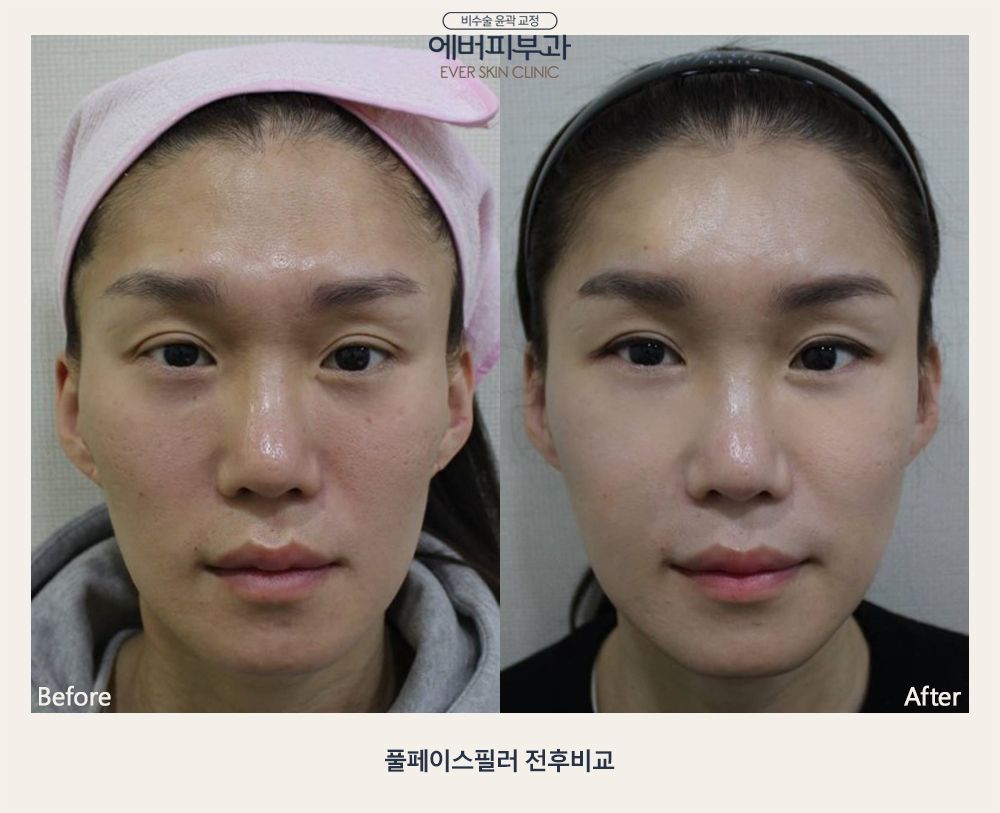
Real patient · before & after
Design-led filler work
This patient received filler across several areas of the face, planned as a whole for balance. It is shown to illustrate our design approach; it does not show a nose filler result.
Ask your dermatologist at consultation for nose-specific cases and what is realistic for your nose.
Photos are shared with the patient's consent and are not retouched apart from privacy blurring. Results differ from person to person and are not guaranteed.
See more before & after photosRecovery & safety
Recovery, side effects and aftercare
Mild swelling or redness may last a few days, and small bruises are possible. The nose has blood vessels connected to those around the eyes, so vascular complications, though rare, are among the most serious filler risks. We use conservative amounts and HA filler that can be dissolved with hyaluronidase.
Tell your dermatologist about previous rhinoplasty, implants or filler, blood thinners, pregnancy or breastfeeding, or skin infection. Seek help immediately if you notice increasing pain, blanching or dusky skin, or any change in vision.
Aftercare tips
- Avoid pressing, pinching or massaging the nose
- Avoid heavy glasses on the bridge for about a week where possible
- Skip saunas, hot baths and intense exercise for 2 to 3 days
- Limit alcohol for a couple of days
- Contact us promptly about pain or colour change
Questions we hear every day
Nose Fillers FAQ
Does nose filler hurt?
Most patients feel only mild pressure or stinging. Topical numbing is used, and the injection itself is brief, so it is usually well tolerated.
How long does nose filler last?
Results often last around a year, sometimes longer, because the nose moves little. Duration varies with the product, the amount used and your metabolism.
Will nose filler make my nose look wider?
It should not when small amounts are placed deep along the midline. Widening usually comes from overfilling or filler spreading, which our design approach aims to avoid.
Is nose filler the same as rhinoplasty?
No. Filler can raise and straighten the nose but cannot reduce size, narrow the nostrils or fix breathing problems. It is a useful option for subtle changes or for previewing a shape before surgery.
Can I have nose filler on a short visit to Seoul?
Yes. The treatment is short with little downtime. We suggest staying at least a day afterwards so we can check the nose, and contacting us immediately if you notice pain or colour change.
Talk to a board-certified dermatologist in Apgujeong
Send us your skin concern and photos on WhatsApp. An English-speaking team member will reply and arrange your consultation.
Mon & Thu 10:00–19:00 · Tue & Fri 10:00–20:00 · Sat 10:00–16:00 · Closed Wed, Sun & holidays